


 451
/ 5
Min Read
451
/ 5
Min Read


India’s delivery economy is expanding at its fastest pace yet, fuelled by double-digit annual growth in online food orders and a consumer base that now prefers the comfort of home over the bustle of dining rooms. The industry is projected to grow over $140 billion by 2030, at a CAGR of around 28.17%.
When Disruptions Becomes Destiny
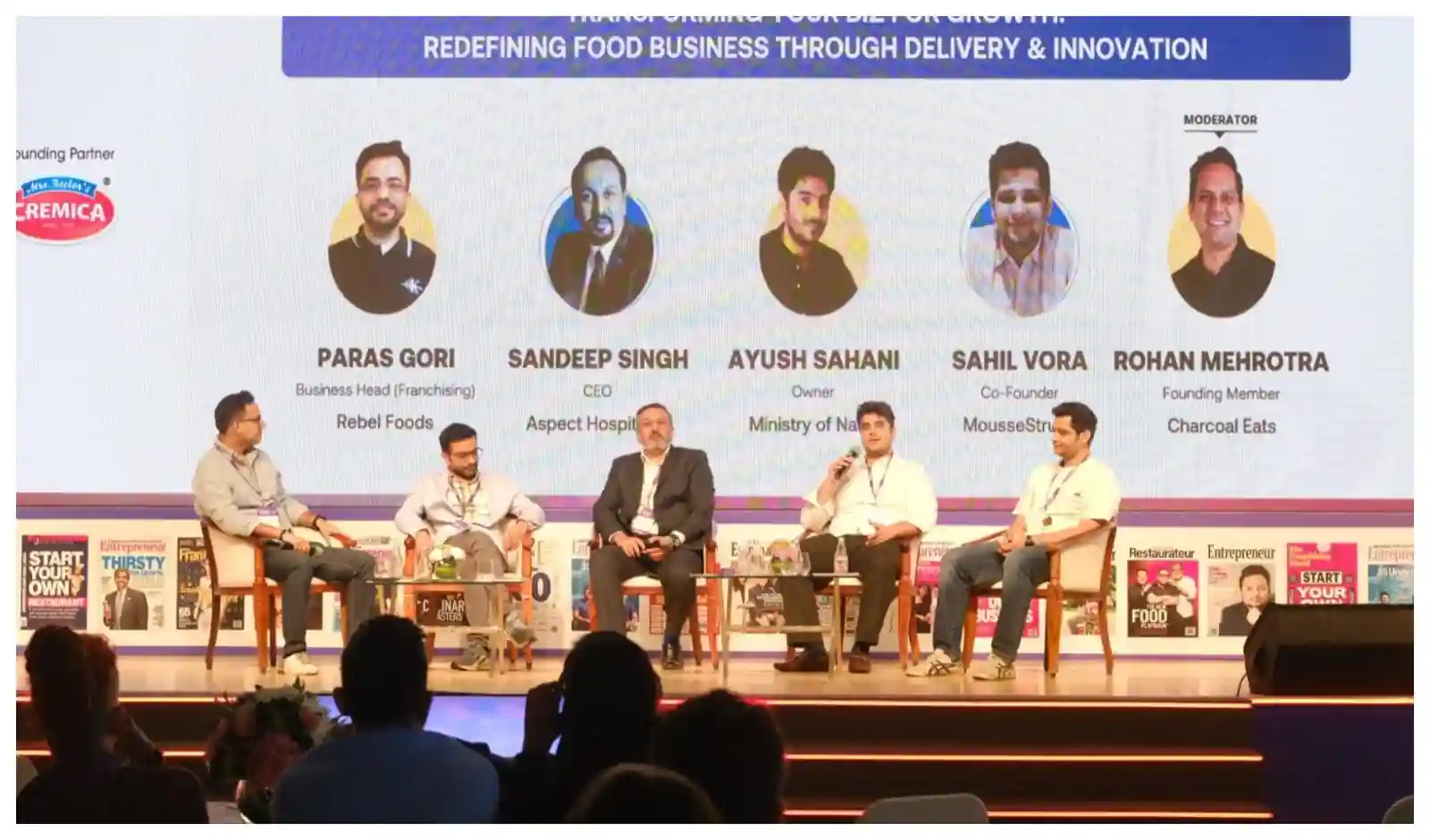
“Delivery has become the forefront of our business right now. A few years back that was not the case. The market has evolved fast and caught us by surprise,” stated Rohan Mehrotra, Founding Member, Charcoal Eats by adding that the shift is no longer optional; it is existential.
Sahil Vora, Chief Eating Officer, MousseStruck, recalls that his dessert brand was born into this disruption rather than adapting to it. “We were born in a situation where we had to come up with products that can stay in a certain temperature for a certain period of time. So, coming up with solutions for this became one of our SOPs.”
MousseStruck emerged during Mumbai’s early delivery surge in 2018–19, when Swiggy and Zomato turned food into a button-tap utility. For Vora, innovation wasn’t a choice as it was about survival.
The Dine-in Awakening
While MousseStruck grew from delivery-first roots, others entered the space with traditional expectations and were quickly humbled.
Aayush Sahani, Founder, Ministry of Naan, admitted, “I thought delivery would be easy… but it’s a very difficult space to be in. Delivery has become part of our life, so I decided to take it as a challenge.”
With years of dine-in experience behind him, his biggest shock wasn’t the operations, it was the margins. “think the rent is low and salaries are fewer, so margins will be good. But delivery margins are really narrow.” As a result, Sahani has restructured his entire restaurant strategy.
“Now, whenever we plan a new dine-in outlet, we give serious thought to the delivery division. It has become essential.”
Bringing the Restaurant Experience Home
For Sandeep Singh, CEO of Aspect Hospitality, known for beloved dining destinations such as Radiobar, OPA, and Akina, the challenge is redefining hospitality without the physical restaurant. “Today want a similar experience at home. They want quality cuisine in quality packaging and delivered in specific amount of time like 15-20min.”
It doesn’t end here; the experience also includes the sensory cues once only found in well-designed dining rooms. Innovation plays an important role. “When the box opens, there has to be steam coming out. Food has to be warm enough to be eaten directly. Boxes need to be as comfortable as plates,” he pointed by adding that Aspect's answer was building scalable delivery-first brands like Nom Nom Express across 50 outlets proof that restaurant craftsmanship can coexist with logistics precision.
Mastering the Multi-Brand Machine
If Aspect represents the dine-in evolution, Rebel Foods represents the delivery revolution. Paras Gori, Business Head, Delivery and Franchising, Rebel Foods explained their multi-brand model. “We built brands around different cuisines like Faasos, Behrouz Biryani, Oven Story Pizza, Lunchbox, Sweet Truth. We are a book-of-brands company.”
Their product innovation pipeline is an industrial process like data-driven, benchmark-driven, and ruthlessly tested. “A product that doesn’t hit our benchmarks doesn’t scale. If it still doesn’t hit it after a certain time, it gets discontinued. Food is an evolving market,” noted Gori.
Delivery may have begun as a convenience, but for Rebel, it's an engine of constant experimentation. “This industry keeps you on your toes. You must always be visible, always experimenting, always innovating. We are in the business before Zomato came in.”
The Invisible Backbone: Rethinking Kitchens and Supply Chains
The rise of delivery has also redefined the physical backbone of the restaurant i.e. the kitchen. Singh described the operational pivot, “When we open a restaurant, we ensure there is self-sufficient kitchen which is formed. The moment you think of scaling, you have to focus on consistency. The customer is testing you every day. So, to scale with consistency, you need a central kitchen, a quality control center, innovations, R&D everything running simultaneously. We have to ensure that the right product with right temperature reaches the customer on right time. There has to be no additional preservatives which spoil the food.”
“If the central kitchen is fully equipped and you are prepared at your restaurants with smaller formats where it has potential for growth, where new equipment's can be fitted in or certain equipment's can be utilized for multiple products, those are the best scenarios and this is where you need to work with right kitchen vendors,” highlighted Singh.
Restaurant kitchens, once built for plating, now require optimal storage, multi-functional equipment, and seamless integration with data systems that track inventory, prep volumes, and demand cycles.
“Every inch of space must be optimally used. With multiple brands in one kitchen, cross-utilization of equipment becomes essential. All decisions are data-driven now and taken into consideration of what can be done.” noted Gori.
From multi-brand prep zones to compact high-output equipment, India’s kitchens are becoming tech-enabled production lines hybrids of craft and engineering. From tech adoption to kitchen redesign, from multi-brand ecosystems to packaging that doubles as plating, India’s restaurant industry is undergoing its most transformative era.
 This article was originally published by the Restaurantindia.in. To read the full version, visit here


