


 104
/ 6
Min Read
104
/ 6
Min Read


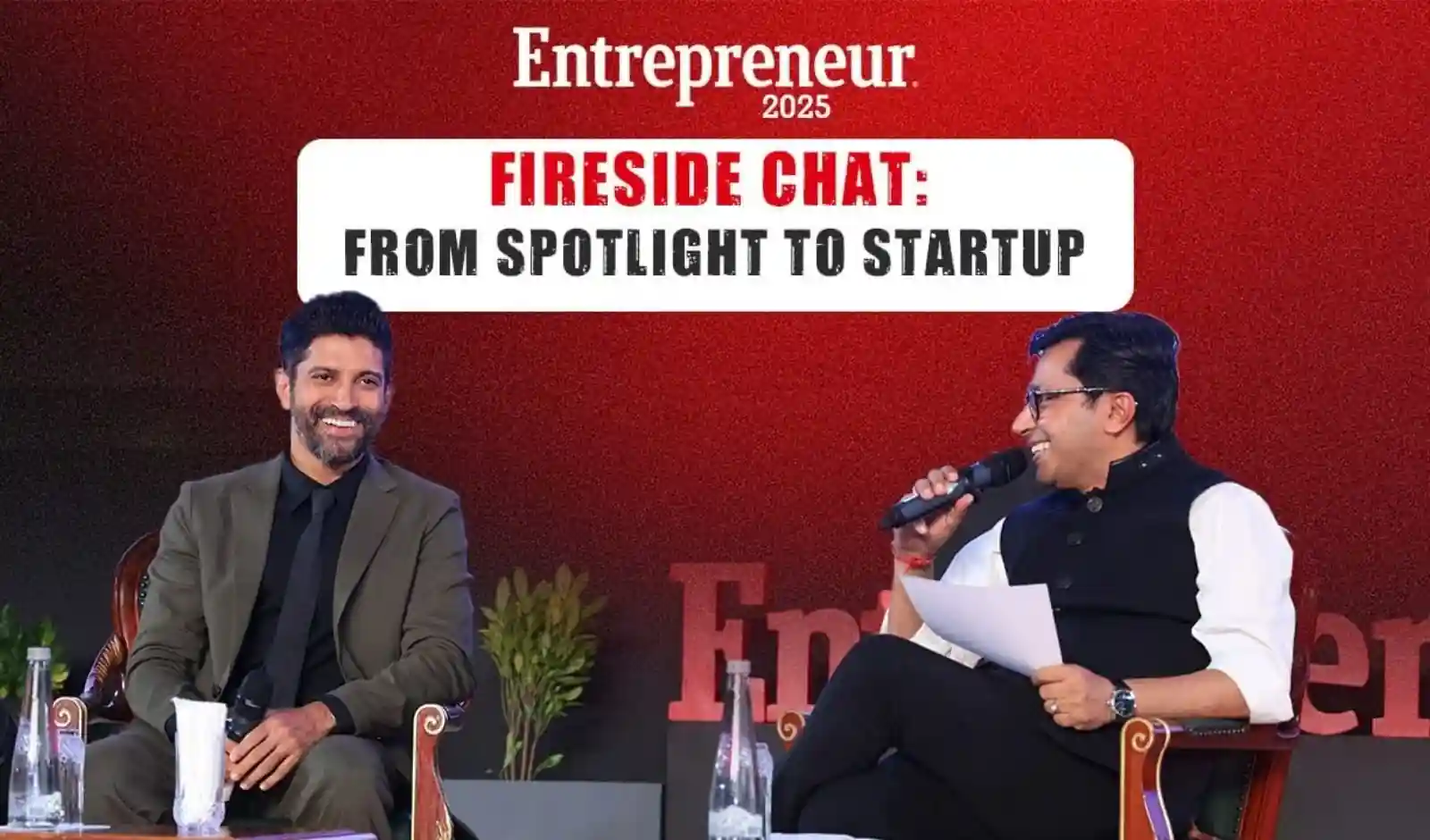
Farhan Akhtar the filmmaker, actor, musician and producer who has spent 25 years juggling art and business, took the stage to a standing ovation at Entrepreneur India's event for founders, funders and creators. His intent was to discuss the structures that support a creative career rather than fame.
After praising the space and the platform and stating that it was "by far, one of the best organised" events he had ever attended, he set the stage the tone for an honest conversation on ambition, accountability, failure and the courage to stay original.
"I loved movies. I loved films. I loved entertaining people," he said early in the session, framing the bedrock of his choices. "Eventually you can only really, really aspire to be as good as you can be in something that you love doing. It was finding and being honest with myself, understanding what my voice could mean what my ambitions were and then being very true to them."
The Art Commerce Equation
Few Indian creators have navigated the tightrope between creative freedom and commercial discipline as visibly as Akhtar. To him, filmmaking is a high-variance business with many variables beyond the script - timing, mood, context, competition. "Filmmaking is risky business. There's no assurance of what will work. The only thing that you can do as a creative person in this field is to be as honest and sincere with your storytelling as you possibly can."
Honesty, though, doesn't absolve responsibility. "There is a very strong business side to the making of movies, one that must be respected. There are people who are putting in their money and their effort. they would also like to reap rewards by at least getting back what it is that they've put in. So that responsibility does not sit lightly on me."
That responsibility informs choices: keeping an "ear on the ground" for shifting audience taste, de-risking through smart pre-sales, and building alliances that use money smartly. "Anyone can get money and make a film. It's how do you get smart money? How do you use the money smartly? …That's what makes a good producer."
Leading From the Front
When he directs, Akhtar embraces the accountability founders in any industry will recognise. "When you're directing a film, you are absolutely the captain of the ship. the example that you set in terms of choices that you make either the creative aspect of a film or the bottom line of a film that responsibility lies with you." Budgets impose boundaries but a "good producer. allows a creator the freedom to make what she or he wants to make and finds ways to provide that at a cost that works efficiently."
The Many Hats and Why Music is Liberation
Across film sets, studios and stages, Akhtar finds one unifying emotion: the gratification of entertaining. "Be it through making movies, making music, performing live on stage with my band, all of it gives me the same gratification as an artist." And yet, he admits, "There is something extremely liberating about music People who can make a career out of music they, to me are the blessed ones in life. They are living the dream."
Failure - Public, Painful and Profoundly Instructive
For creators in the public gaze, failure isn't private. It's headline-sized. "Dealing with failure is a very, very public thing. So it hits home a lot harder when it happens." He cites his second film, Lakshya, as both a professional heartbreak and a lifelong lesson. "Putting that film together, to me was a success unto itself Sometimes we forget about that success because we are so used to validation from other people and what they think."
Thirteen years after its average box office an unexpected moment in Dehradun reframed everything. At the Indian Military Academy, when a faculty member asked cadets how many joined because of Lakshya almost 60% of kids put their hands up. Akhtar says, "It redefined what success means we forget that filmmaking is also an art that touches people's lives After that, if a film doesn't work, I always feel that there's some pot of gold at the end of the rainbow somewhere."
Staying Grounded and Staying Real
Authenticity for Akhtar is sustained by the people who knew him before the posters. "My closest circle of friends have nothing to do with the film industry For them, it doesn't matter whether I'm riding the crest of success or I'm lying in the pits of despair after failure. They're always exactly the same That really keeps me grounded." The lesson carries to public life: "It's important to not fool people and try and be someone that you're not if they do like you, it's what they like you for."
The Books, The Dreams, The Habits
Among books that shaped his thinking, he cites The Tipping Point as "a really good read" on how ideas become obsessions. On collaboration, the dream remains the actor whose work propelled him into cinema "Robert De Niro I have this fantasy that someday I will end up working with him in some capacity." As for what keeps him centred? "Just being with my friends."
The One Piece of Advice
The counsel he offers to every aspirant on stage or off, is stark and simple. "Everyone has their own personal story to tell please be an original. Do not be a cheap imitation, or even a great imitation of someone else You have a voice, you have a story, please be honest to that, be authentic with that and the world will come to love you for it."
A Closing Note in Verse
Before the awards that evening Akhtar shared a poem from his initiative MARD (launched to engage young men on the idea of masculinity), followed by lines from Zindagi Na Milegi Dobara. The room fell into the cadence of carefully chosen words:
"In whose eyes there is a shining light like the deep glory
Which has a culture in its style
Whose style is soft
There is tameez in words
In whose heart and in whose words
In reality, women have complete respect and also complete dignity.
One who respects the body, mind and life of a woman
Who cares about the self-respect of women every moment
The woman who never forgets even for a moment is a human being
Whoever knows his own identity
which also has power
Who also has courage
In which there is pride and self-confidence
who is with you
Joe if I have
Because of his presence, women feel safe.
He who is a true companion of woman, a friend, a sympathizer
This is the truth
He is a man"
 This article was originally published by the Entrepreneurindia.com. To read the full version, visit here


