


 46
/
5
Min Read
46
/
5
Min Read



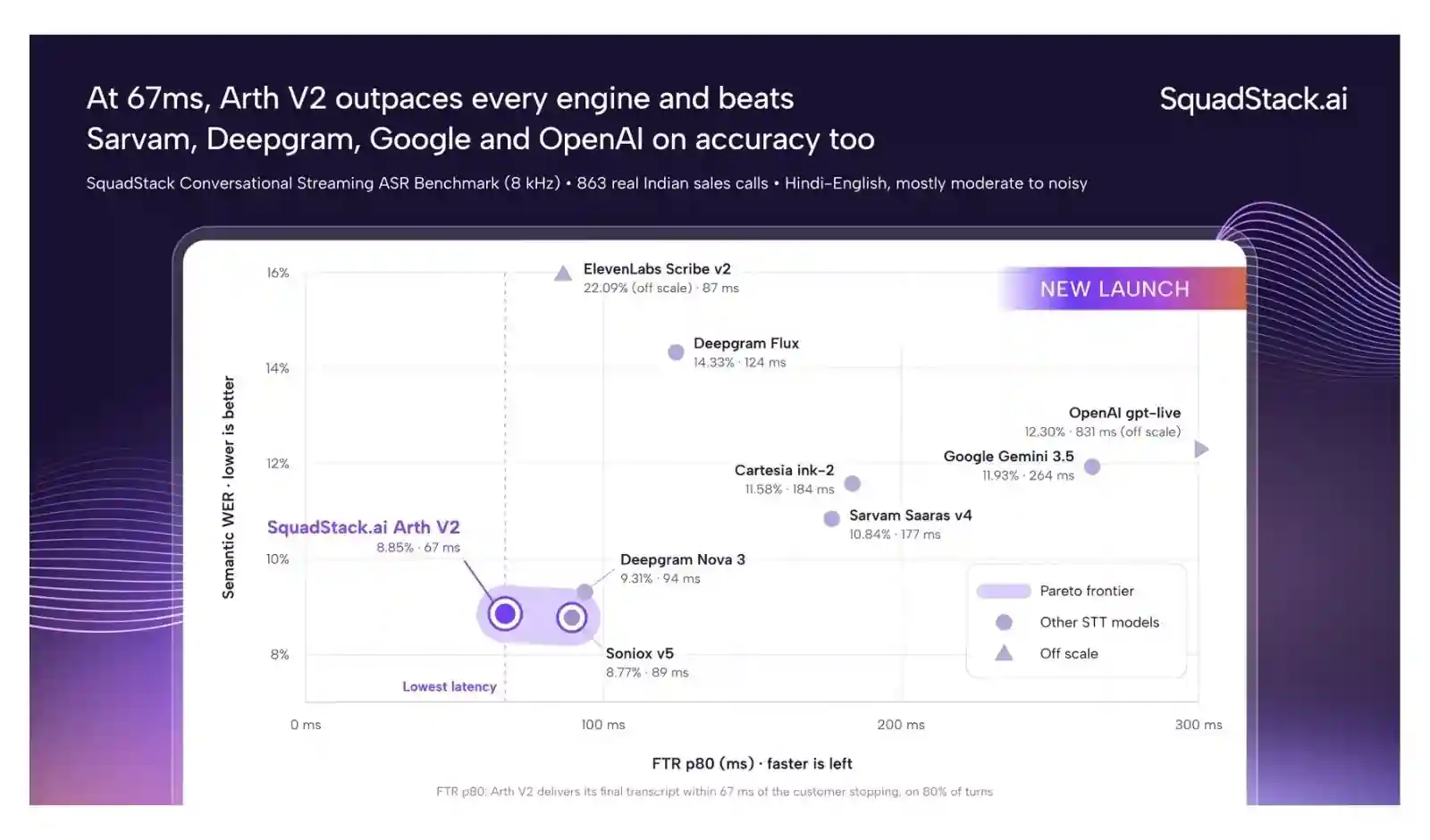
SquadStack.ai, which builds and operates outcome-driven Voice AI Sales Agents for leading Indian consumer brands, has launched Arth V2, a streaming speech-to-text model designed for Indian sales conversations. The company said the model outperformed several global and Indian competitors on its SquadStack Conversational Streaming ASR Benchmark (8 kHz), recording a semantic word error rate of 8.85% and the lowest latency among the engines tested.
Arth V2 is the first model from SquadStack.ai’s in-house model factory. It is designed to recognise speech in real-world Indian sales calls, where customers frequently switch between languages, speak over agents and communicate in noisy environments. The company said the model has already handled more than 1 crore minutes of live customer calls in two months.
“Speech AI improves so quickly that a model which ships once and stays frozen is out of date within a month,” said Vikas Gulati, Co-founder and CTO of SquadStack.ai. He explained that the company’s self-improvement system, Lift, uses calls where words were misrecognised to improve subsequent versions of Arth. The company expects to release updated versions every few weeks.
Arth V2 Records 67ms Latency on Company Benchmark
According to SquadStack.ai, Arth V2 recorded an 8.85% semantic word error rate on its 8 kHz telephony benchmark, performing ahead of Sarvam, Deepgram, Google, OpenAI, Cartesia and ElevenLabs on the combined measures of accuracy and speed.
The company said Arth V2 made 18% fewer meaning-changing errors than Sarvam Saaras v4, 26% fewer than Google Gemini 3.5 Transcribe, 28% fewer than OpenAI gpt-live-transcribe and 60% fewer than ElevenLabs Scribe v2 Realtime.
Arth V2 delivered its final transcript within 67 milliseconds of a customer stopping speech on 80% of turns, according to the company. SquadStack.ai said this was 2.6 times faster than Sarvam and 12 times faster than OpenAI on the benchmark. Soniox v5 recorded a slightly lower error rate of 8.77%, but with higher latency, the company said. SquadStack.ai claims no other engine tested matched Arth V2 on both accuracy and speed.
The model also showed improvements in recognising numbers, including loan amounts, EMI dates and PIN codes. These details can be important in sales conversations, where a misheard figure may affect the next response or action taken by an AI agent.
Benchmark Focuses on Real Indian Telephone Conversations
The SquadStack Conversational Streaming ASR Benchmark was built using 863 real Indian sales calls. According to the company, the recordings feature unscripted conversations in which customers pause, interrupt agents and switch languages mid-sentence.
More than four in five minutes of speech are code-mixed, while nearly nine in ten contain background noise, the company said. The benchmark uses 8 kHz narrowband telephone audio, which limits the audio frequency range compared with wider-band recordings. Each speech recognition engine is tested in streaming mode, processing audio as the customer speaks.
The scoring method focuses on errors that change the intended meaning rather than treating every transcription mistake equally. For example, in one benchmark call, a customer says “chhah hazaar nau sau hai”, referring to ₹6,900. SquadStack.ai said Google Gemini transcribed the amount as ₹1,900, Sarvam as “chaar nau sau” and OpenAI as “nau sau”, while Arth V2 recognised the amount correctly.
The company said the benchmark’s call recordings and speakers do not overlap with the audio used to train Arth. The test audio, reference transcripts and scoring methodology have also been made available on Hugging Face for teams to evaluate their own speech recognition systems.
Trained on Indian Sales Conversations
SquadStack.ai said Arth was trained in-house from scratch on more than 60 crore minutes of Indian sales conversations involving over 10 crore unique speakers. The training data covers more than 85% of India’s PIN codes and a wide range of regional dialects and accents, according to the company.
Arth currently powers 80% of the more than 50 lakh AI calls that SquadStack.ai makes each day, the company said “Every sales conversation starts with hearing the customer correctly,” said Apurv Agrawal, Co-founder and CEO of SquadStack.ai. He noted that speech-to-text remains a major potential point of failure for Voice AI agents because an incorrect transcript can lead to an incorrect response.
Agrawal added that customers speaking Hindi in different regions, such as Patna and Ludhiana, can have distinct accents and may switch to English during a conversation. Drawing on more than six years of experience operating AI-native contact centres for Indian consumer brands, the company has developed Arth to address these challenges. He said owning its speech models allows SquadStack.ai to use insights from customer calls to improve future performance.
Arth V2 Available in Closed Beta
Arth is already integrated into SquadStack.ai’s Voice AI Agents for its enterprise customers. Arth V2 is also available in closed beta for teams interested in testing the model on their own calls. The company said its model development approach will focus on regular improvements based on real-world call performance. The commercial adoption of Arth V2 beyond its existing deployments will depend on how it performs across different use cases and customer environments.
The release marks SquadStack.ai’s effort to build speech recognition technology tailored to Indian telephone conversations, where language mixing, regional accents, background noise and the accurate recognition of numbers can directly affect customer interactions.


