


 98
/
4
Min Read
98
/
4
Min Read


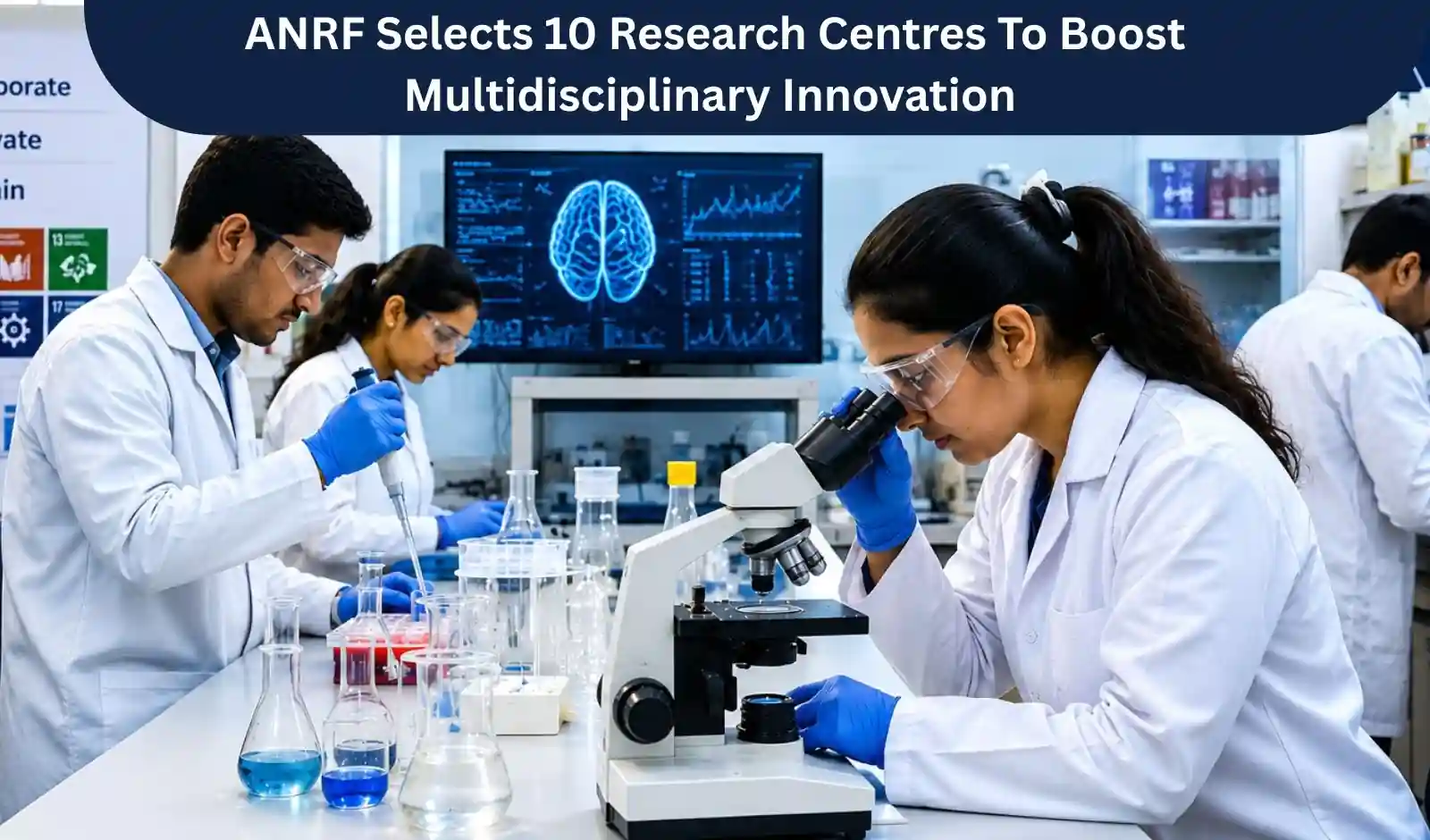
To give a new direction to multidisciplinary education and research in the country, the Anusandhan National Research Foundation (ANRF) has selected 10 new “Convergence Research Centres of Excellence” (CoEs). These centres aim to promote research by integrating science, social sciences, humanities and technology to address complex social and national challenges.
According to a statement issued by the Ministry of Science and Technology, the initiative will strengthen multidisciplinary and transdisciplinary research by establishing deeper collaboration across different fields of study. It will focus on combining scientific knowledge with social sciences and humanities to create new research opportunities and innovative solutions.
Major Educational Institutions Selected
The institutions selected under this programme include IIT Gandhinagar, NIAS Bengaluru, IIT Madras, NIT Agartala, IHD Delhi, IIT Dharwad, IIM Jammu, IIT Kanpur, Chanakya University and PSGR Krishnammal College for Women.
Research at these centres will focus on important areas such as archaeology, traditional knowledge systems, digital humanities, rural development, healthcare and computational economics. Education experts believe that this initiative can play a significant role in promoting innovation, advanced learning and technological development in the education and research sector.
Strong Focus on Interdisciplinary Research
Under this programme, interdisciplinary and multidisciplinary collaboration has been made mandatory within institutions as well as among various ministries, departments, public institutions and private organisations.
The co-researchers associated with these centres come from diverse academic and research institutions across the country. These include state universities, central universities, IITs, NITs, private universities, colleges and recognised research and development institutions.
10 Centres Selected from 945 Proposals
The ANRF programme received an overwhelming response from educational and research institutions across India. A total of 945 proposals were submitted, out of which only 10 research centres were selected.
Experts believe that the large number of proposals reflects the growing importance and relevance of multidisciplinary research in India’s education ecosystem. It also highlights the increasing interest among institutions in collaborative and innovation-driven research.
Initiative Linked to NEP 2020 and Viksit Bharat 2047 Vision
The “Convergence Research Centres of Excellence” programme is inspired by the National Education Policy (NEP) 2020, which strongly emphasises multidisciplinary education, research and integration of different knowledge domains.
The initiative is also aligned with the vision of “Viksit Bharat 2047,” which aims to transform India into a developed, innovative, self-reliant and knowledge-driven nation in the coming decades.
Boost for AI, Robotics and Big Data Research
According to experts, technologies such as Artificial Intelligence (AI), robotics, big data analytics, and digital technologies are rapidly becoming a major part of education and research. In this context, the programme can help create better coordination between scientific and social research to address emerging technological and societal challenges.
ANRF believes that combining scientific knowledge with social understanding can provide holistic solutions to regional and national problems. The initiative can also contribute significantly to achieving Sustainable Development Goals (SDGs) and strengthening socio-economic progress.
Major Benefits for Students and Research Scholars
Educationists say that this initiative will provide students, research scholars and young scientists with access to modern research facilities, advanced laboratories and collaborative opportunities. Working with experts from multiple disciplines will help students understand new dimensions of research and develop practical solutions to real-world challenges.
Through these new research centres, students and scholars will get opportunities to work on modern technologies such as AI, robotics, GeoAI, big data, digital humanities and data science. This will help prepare young learners for future technology-driven careers and advanced research opportunities.
Greater Collaboration Among Higher Education Institutions
The initiative will strengthen collaboration among IITs, NITs, universities, and research institutions. This can create opportunities for students and faculty members to participate in joint research projects, internships, exchange programmes and advanced research laboratories.
Experts believe that this collaboration will make India’s higher education and research ecosystem stronger, more modern and globally competitive.
Research on Rural and Social Challenges
The research centres will also focus on areas such as rural development, healthcare, environmental studies, traditional knowledge systems, and social development. This will allow students to understand real societal challenges and develop practical solutions for them.
The initiative aims to connect education not only with academics but also with social and national development. Education experts believe that it can give a new direction to grassroots-level research and social innovation.
India’s Participation in Global Research and Innovation to Increase
According to education experts, such multidisciplinary research centres can help India emerge as a global hub for research and innovation. This will provide Indian students and researchers opportunities to participate in international projects, research collaborations and global academic networks.
Experts believe that in the coming years, this initiative can accelerate India’s scientific and technological progress while also strengthening the country’s position in the global education and research landscape.


