


 147
/
3
Min Read
147
/
3
Min Read


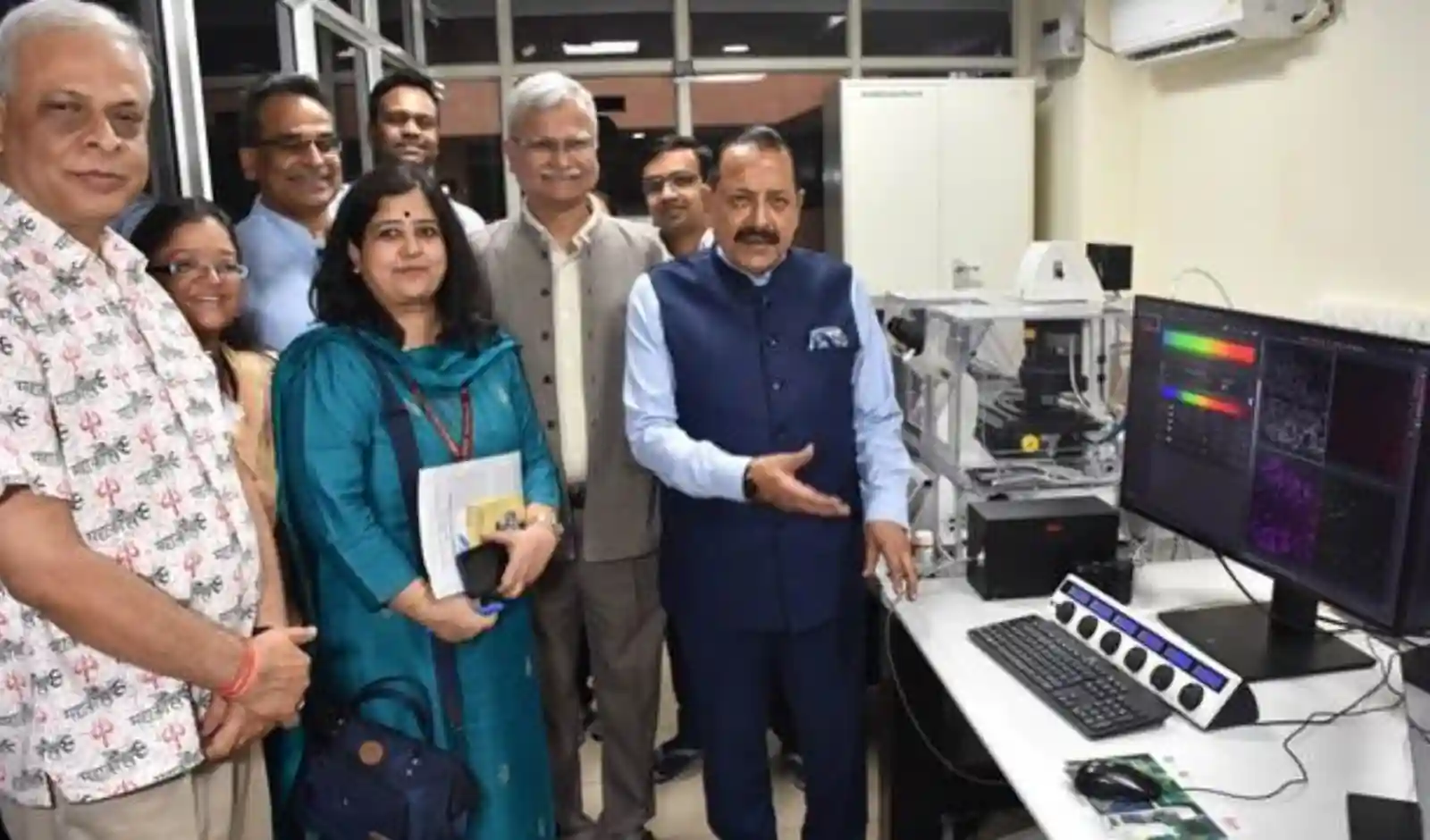
During the visit, he conducted a detailed review of the centre’s scientific infrastructure, research capabilities and future development plans. The minister stated that “SAATHI-BHU” has emerged as a strong national hub for advanced scientific research, innovation and industry-academia collaboration in India. He appreciated Vice-Chancellor Professor A.K. Chaturvedi and the university faculty, saying that this model serves as an inspiration for other educational institutions across the country.
Government Focus on Strengthening Science and Research
Dr. Jitendra Singh said that the Department of Science and Technology is rapidly expanding scientific infrastructure and research support systems in universities and higher educational institutions across India. The objective is to provide students, researchers and startups with easier access to advanced technologies and modern scientific facilities.
He explained that initiatives such as “SAATHI,” “FIST,” “ARRF,” and other research support programmes are playing an important role in strengthening research, innovation, startups and industry-academia partnerships. These initiatives are particularly benefiting young researchers, MSMEs and emerging startups.
Modern Research Centre Developed with ₹72 Crore Support
“SAATHI-BHU” has been developed with financial support of nearly ₹72 crore from the Department of Science and Technology. It is a national-level shared scientific infrastructure facility where educational institutions, research organisations, industries, MSMEs and startups can access advanced scientific equipment and technical services.
The centre operates under a Section-8 company model and has now become one of the country’s leading multidisciplinary research and analytical support centres.
World-Class Facilities for Students and Researchers
Several cutting-edge scientific facilities have been installed at SAATHI-BHU. These include super-resolution confocal microscopy, live cell imaging, advanced NMR spectroscopy systems, high-resolution mass spectrometry, clean room facilities, electrochemical workstations, chromatography platforms and isotope analysis systems.
These facilities are being used in fields such as life sciences, pharmaceuticals, healthcare, semiconductors, food science, environmental science, biotechnology and advanced material research.
Boost to Research and Industry Collaboration
The minister said that connecting universities and research institutions with modern technological infrastructure is essential to promote scientific thinking and innovation-driven education in the country. He added that several universities and colleges are being linked with space science, emerging technologies and research programmes to prepare students for future technologies.
He further emphasized that strengthening scientific infrastructure in universities is necessary to achieve the vision of Atmanirbhar Bharat and make India globally competitive in emerging technologies.
Services Provided to More Than 1,100 Users
Officials informed that SAATHI-BHU has so far provided services to nearly 1,100 users from academia, research institutions, and industries. More than 30,000 samples have been processed at the facility and around 1,000 researchers and stakeholders have received training.
Additionally, nearly 60 short-term training programmes have been organised for capacity building and awareness enhancement.
Moving Towards NABL Accreditation and Global-Level Research
Dr. Jitendra Singh appreciated the efforts of SAATHI-BHU in obtaining NABL accreditation and developing a sustainable research and analytical service model in collaboration with industries.
He said the centre has contributed to high-quality research publications, patents, and collaborative partnerships with national laboratories and industrial stakeholders, thereby strengthening the connection between science, innovation, and economic development.
Why Is This Initiative Important for Education and Innovation?
According to experts, centres like SAATHI-BHU can play a major role in giving a new direction to research and technical education in India. It will provide students and researchers access to world-class scientific instruments that were previously limited to select institutions.
This initiative will also strengthen the goals of the National Education Policy (NEP 2020), Atmanirbhar Bharat and India’s vision of becoming a global knowledge and innovation hub.


