


 253
/
4
Min Read
253
/
4
Min Read


As India’s tech sector adjusts to a prolonged hiring slowdown and muted salary growth, companies are increasingly rethinking how they retain talent moving beyond pay hikes to structural workforce strategies, according to a new report by upGrad Rekrut- the talent & staffing division of global skilling major upGrad.
The ‘2025-26 Talent Landscape & AI Integration Report’, based on responses from 3200+ HR leaders and tech professionals, finds that India’s tech slowdown is not uniform. While Tier-2 and Tier-3 cities are emerging as stability hubs for employers, the impact of this reset is uneven across demographics, even as AI hiring continues to rise.
Key Findings Include:
- India’s tech slowdown is uneven. While overall hiring has moderated, companies are reshaping workforce strategies instead of relying solely on higher pay to retain talent.
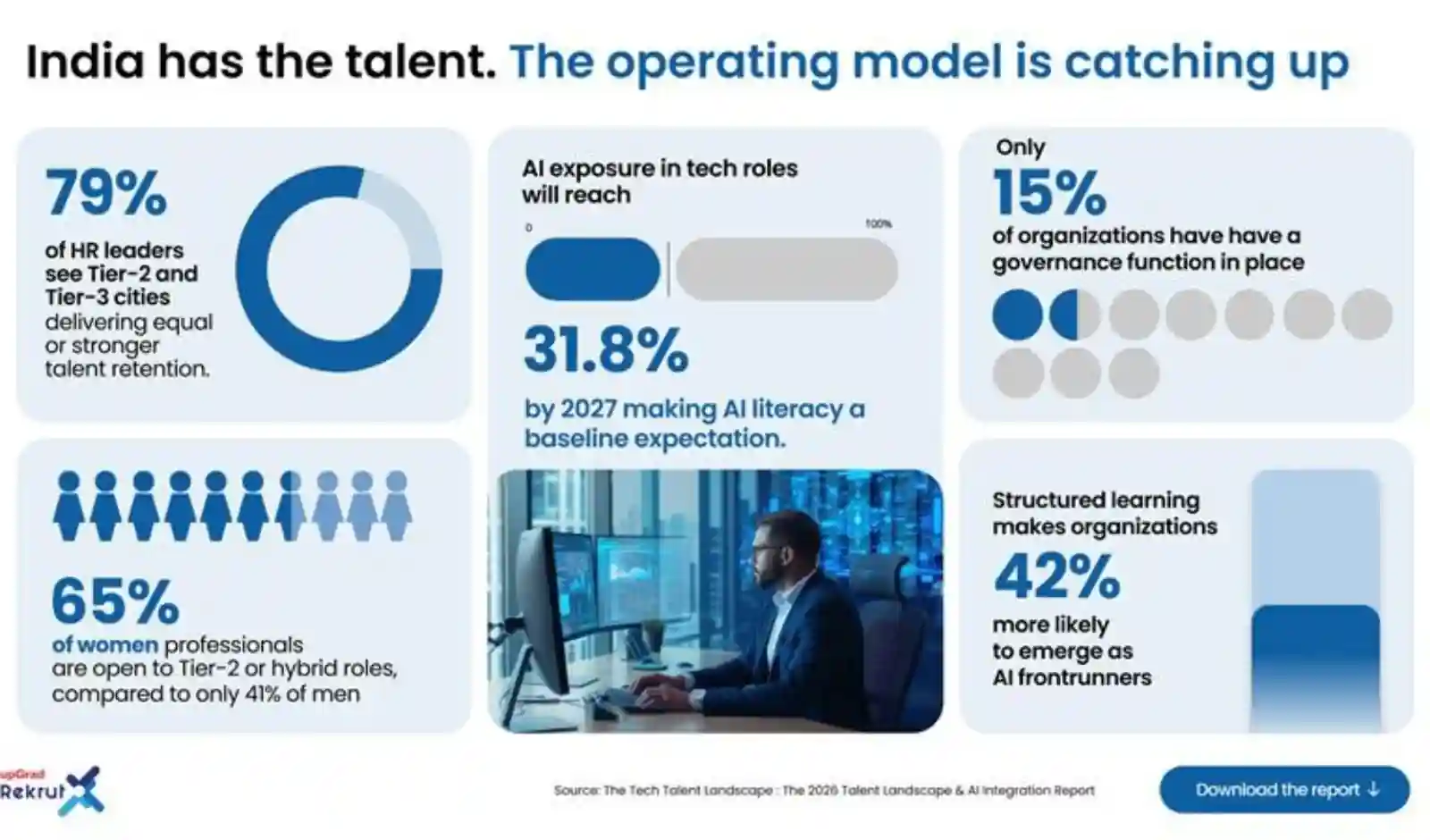
- 79% of HR leaders say retention in Tier-2/3 cities is equal to or better than Tier-1 metros.
- Tech hiring in these cities is expected to rise from 12.3% to 19.7% by FY27, reflecting a shift from cost-led expansion to continuity-driven planning.
- 65% of women professionals are open to Tier-2 or hybrid roles; Yet women account for only 35% of India’s tech workforce, signalling a missed stabilisation opportunity in an employer-led market.
- While AI roles continue to expand, only 15% of firms currently have formal AI governance frameworks in place, raising risks around employee confidence, trust and retention.
- The report cautions that without mature hybrid work models and AI governance frameworks, AI-led growth could intensify workforce churn rather than offset it.
Commenting on the findings Husain Tinwala, President, upGrad Rekrut, said “The data points to a clear shift from compensation-led retention to architecture-led retention. In an environment of flat pay cycles and higher compliance costs, companies are increasingly using location strategy, workflow redesign, and learning access as substitutes for wage escalation. Tier-2 cities are emerging as stability hubs not because they are cheaper, but because they offer lower attrition and longer workforce continuity. However, this model only holds if hybrid work and AI governance mature in parallel. Without those enablers, the same reset that improves retention for some segments could accelerate exits among women and mid-career professionals, turning AI-led growth into a churn risk rather than a capability advantage.”
Separately, based on upGrad Rekrut’s operating data over the past 12 months, the company has seen a nearly 40% increase in placement mandates originating from Tier 2-3 regions. This growth has been driven largely by demand for AI engineers, data analysts and automation specialists, particularly across BFSI, IT services and manufacturing. Emerging hubs such as Ahmedabad-GIFT City, Coimbatore, Kochi, Indore and Lucknow now account for close to one-fourth of all AI-linked hiring mandates handled by the company, indicating a sustained shift in where advanced technology roles are being created.
As pay growth plateaus, the data indicates that workforce stability will increasingly depend on whether companies can translate intent around location strategy, hybrid work, learning access and AI governance into durable operating models rather than one-off initiatives.
The responses were validated through cross-tabulation across global capability centres (GCCs), multinational corporation (MNC) subsidiaries and Indian enterprises. The geographic split comprised 74.7% respondents from Tier-1 cities and 25.3% from Tier-2 and Tier-3 cities. Key respondent locations included Mumbai, Bengaluru, Delhi NCR, Hyderabad, Pune, Chennai, Kolkata, Ahmedabad, Jaipur, Indore, Coimbatore and Chandigarh, among others.


