


 95
/ 5
Min Read
95
/ 5
Min Read


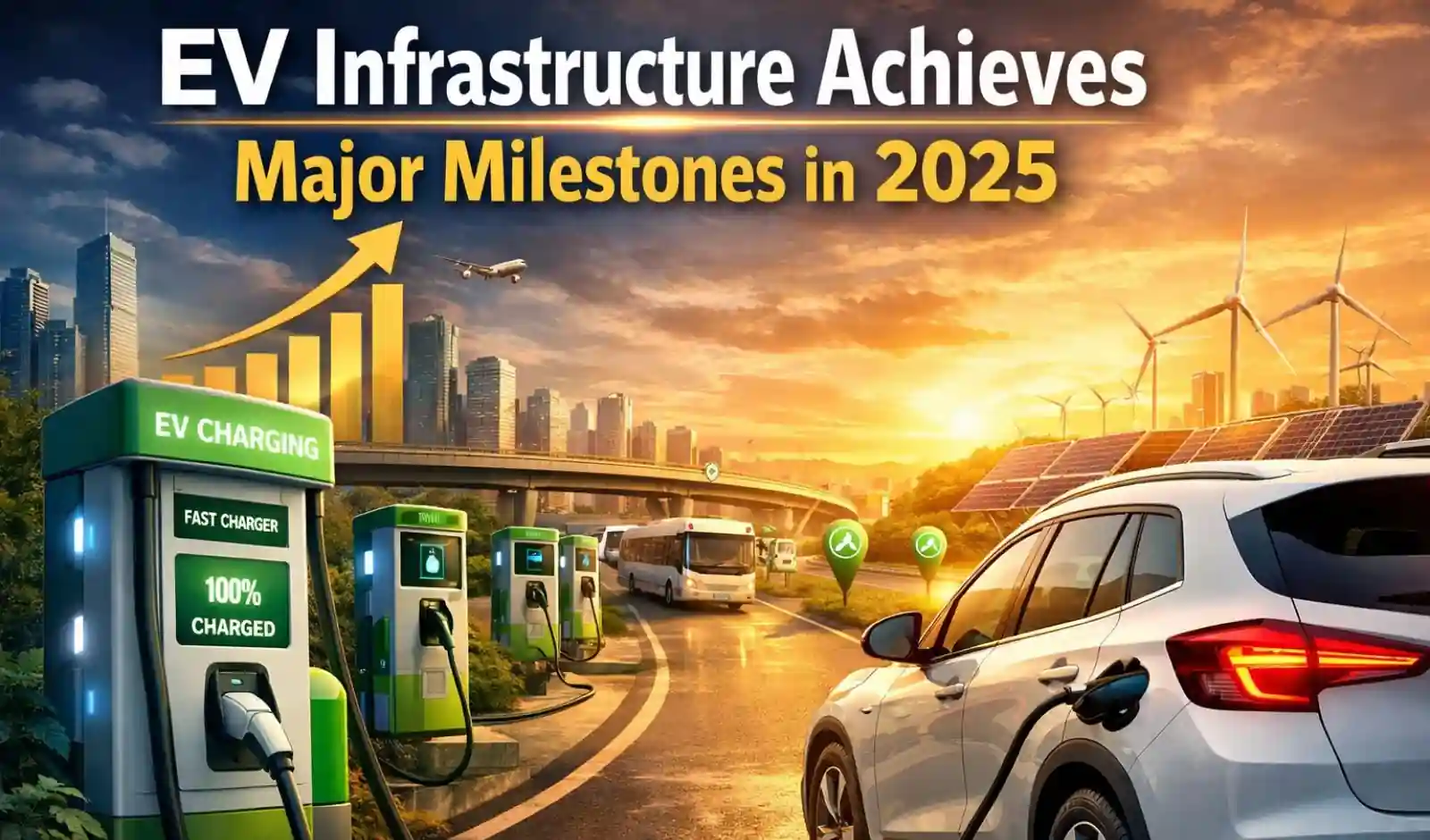
The year 2025 emerged as a milestone for India’s electric vehicle (EV) sector. It was a year when the EV ecosystem moved beyond early-stage expansion to take solid steps toward reliable infrastructure, real-world adoption, and large-scale implementation. Government policies, rapid expansion of charging networks, growing confidence in commercial fleets, and aggressive strategies by private companies collectively accelerated India’s green mobility journey. This article highlights the major developments in 2025, the achievements of leading companies, and the potential steps for the sector in 2026.
On EV infrastructure, Akshit Bansal, CEO and Founder of Statiq, said, “This year, India’s electric vehicle sector has made significant progress. The key drivers of growth have been smart government policies such as subsidies and incentives, coupled with a growing nationwide trend toward clean and sustainable mobility. By November 2025, the number of public charging stations in India crossed 29,000, up from just 6,586 in 2023. This is more than four times the previous number. Of these, over 4,577 stations were installed on highways as per plan. This increase in charging infrastructure has laid a strong foundation for EV growth. Although global supply chain challenges and economic pressures persist, the rise in stations has made EVs more accessible and practical for daily commuters, whether for city travel or long-distance journeys, reducing range anxiety and motivating more people to switch from petrol vehicles to EVs.”
“Statiq has expanded its presence to 100 cities and now operates over 10,000 charging stations. In 2025 alone, we added 3,000 new stations, providing fast and reliable power in busy urban centers and growing semi-urban areas, building genuine trust among EV owners. Our user-friendly app, quick-charging technology, and 24/7 support have turned long journeys into stress-free experiences. This demonstrates that electric cars can now compete with petrol and diesel vehicles in terms of convenience. In 2026, we aim to install 20,000 advanced chargers with smart features such as real-time availability, app-based payments, and AI-optimized fast charging in partnership with automakers and real estate developers. This will make charging as fast and convenient as refueling at a petrol pump. Our clear goal is to establish affordable, large-scale EV charging stations across Tier 1, Tier 2, and even Tier 3 areas, promoting India’s green mobility transition and helping millions adopt sustainable driving for a cleaner future.”
Raghav Bharadwaj, CEO and Founder of Bolt.Earth, added, “This year marked a consolidation phase for India’s electric mobility ecosystem, where the focus shifted from early adoption to reliable, everyday charging availability. Bolt.Earth’s network has now reached over 100,000 chargers across 1,800 cities and towns, accounting for nearly 63% of India’s public charging market. We have also witnessed growing adoption of our fast-charging solutions, including Blaze DC for high-utilization public and commercial locations, and Lightning DC for fleet operators and high-throughput corridors, catering to diverse and rapidly increasing charging needs. We are on track to achieve $5 million in revenue in FY2025 and continue progressing toward profitability by FY2026–27. Our model of enabling charger hosts across residences, workplaces, and commercial locations has improved utilization and unit economics, making EV infrastructure increasingly sustainable. Looking ahead, the next phase will focus on scaling fast-charging density and significantly increasing annual deployments as EV adoption accelerates across India.”
Himanshu Aggarwal, Investor & Strategy Lead at Zenergize, deep-tech entrepreneur, and energy transition enthusiast, said, “2025 clearly demonstrated that EVs are no longer a distant future—they are becoming a present reality. Electric two-wheelers, three-wheelers, buses, and now trucks have all moved from pilot projects to real scale. This year also highlighted that it’s not just the number of chargers that matters, but reliability, uptime, and infrastructure suited to Indian conditions are the real game-changers. Moving into 2026, the next big goal is to build a strong charging backbone with indigenous technology and smart energy management.”
Benny Parihar, Founder and Managing Director of EVERTA, “Government support at both the central and state levels has been pivotal in shaping India’s EV charging ecosystem. Initiatives like PM E-DRIVE and progressive state EV policies have helped move the sector from expansion to execution in 2025.
This year, EVERTA launched its Made-in-India high-performance DC fast chargers and set up a manufacturing facility in Bengaluru, positioning the company to produce 3,000 chargers annually by 2027 and target a 15 % share of India’s DC charger market by 2030. The focus has shifted from charger counts to reliability, uptime, and real-world usability—especially for fleets and high-usage corridors. While DC fast-charger deployment continues to gain momentum, the industry still faces challenges around grid readiness and standardisation. Going forward, localisation and Made-in-India charging solutions designed for Indian conditions will be critical in enabling dependable scale and accelerating mass EV adoption.”
Conclusion
The year 2025 has elevated India’s electric vehicle sector to a new level, focusing not just on expansion but on reliable infrastructure, real-world adoption, and large-scale implementation. Companies like Statiq, Bolt.Earth, Zenergize, and EVERTA have made EVs more accessible and sustainable through charging networks, fast-charging technology, and smart features. With government support and localization, the EV sector has transitioned from a distant future concept to a present reality. While 2026 will bring both challenges and opportunities, with strong strategies, indigenous technology, and coordinated efforts, India is poised to advance even more rapidly on the path of green mobility.


