


 291
/
4
Min Read
291
/
4
Min Read


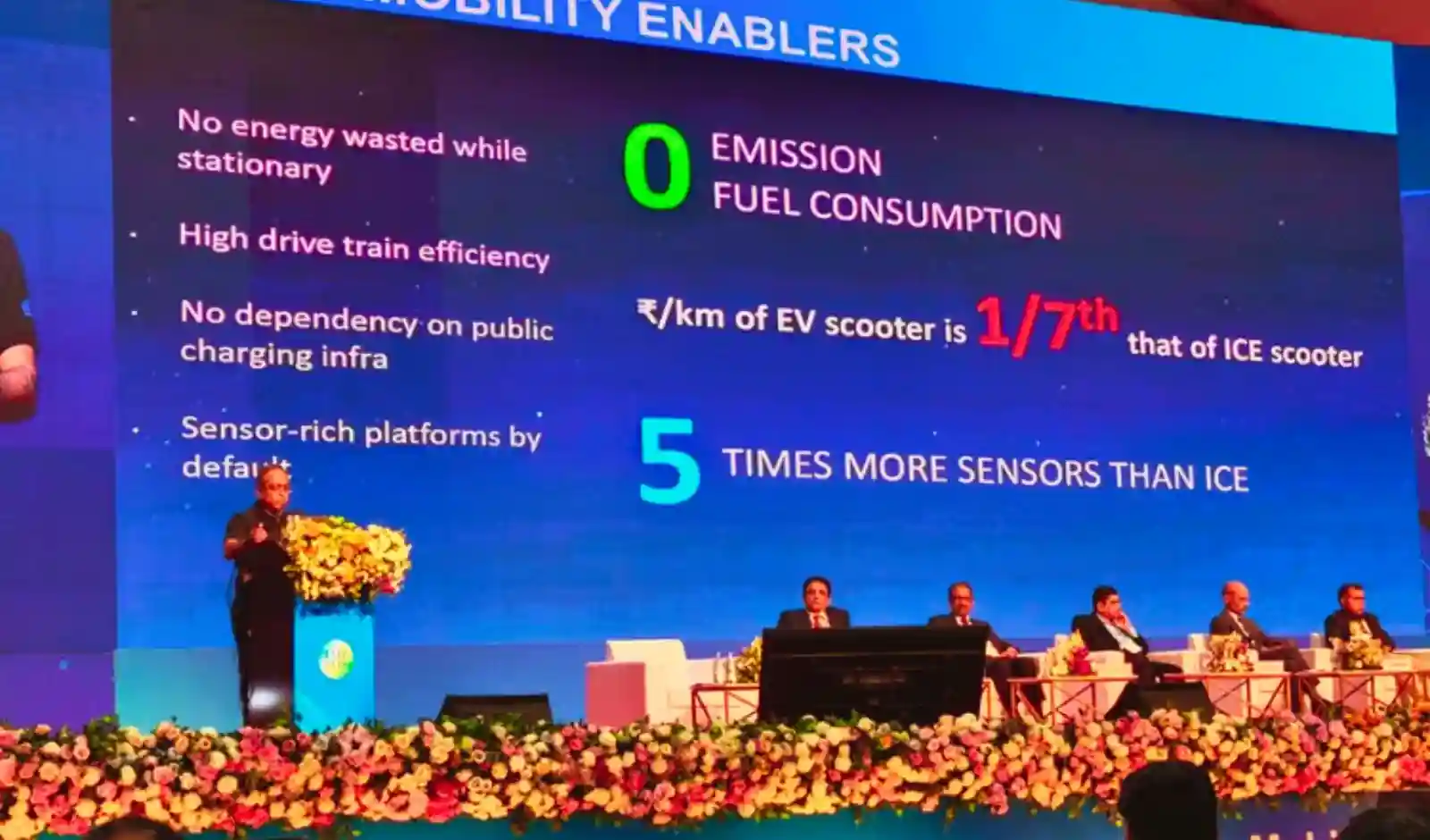
Electric two-wheelers and three-wheelers will play a central role in India’s transition to cleaner and more efficient urban mobility, as dense traffic conditions and limited road space make smaller electric vehicles far more effective than cars, a senior Bajaj Auto official said.
Speaking at the Symposium on International Automotive Technology (SIAT) 2026, Abraham Joseph, Managing Director of Bajaj Auto Technology Ltd., said India’s mobility challenge is driven by congestion rather than distance. “India’s problem is not distance, it is density. You have far more vehicles than the infrastructure can sustain,” he said.
Two-wheelers and three-wheelers form the backbone of urban transport in India due to their scale and space efficiency. The country has around 260 million two-wheelers on the road, compared with about 50 million cars. Joseph noted that two-wheelers occupy nearly a quarter of the road space used by cars while costing significantly less, making them better suited for daily commuting in congested cities.
He said India’s mobility requirements differ from those in Europe and North America because of traffic density, heat, dust and road conditions. In such environments, electric scooters and three-wheelers offer clear advantages, as they consume no energy while idling and recover energy through regenerative braking, improving real-world efficiency and reducing emissions.
Joseph highlighted that internal combustion engine (ICE) scooters are inherently inefficient in stop-and-go traffic due to energy losses from centrifugal clutches and rubber-belt CVT transmissions. Electric scooters, by contrast, avoid these losses and deliver power only when required. As a result, replacing ICE scooters with electric ones can sharply reduce ownership costs. “An electric scooter’s total cost of ownership is about 38 per cent of that of an ICE scooter,” he said, adding that regenerative braking can recover nearly 70 per cent of energy.
Electric three-wheelers also deliver strong economic benefits. Compared with diesel models, they offer more than a 15 per cent improvement in total cost of ownership, along with lower operating and maintenance expenses. Their suitability for last-mile transport further boosts earnings for operators.
Bajaj Auto said its growing EV portfolio has delivered measurable environmental benefits. Over the past five years, the company’s electric vehicles have helped save approximately 230,000 tonnes of carbon dioxide emissions. High daily utilisation of two- and three-wheelers, Joseph said, amplifies the environmental impact of electrification and aligns well with India’s ESG and regulatory objectives.
India’s EV market continued to expand in 2025, led by mass-market segments. Sales of electric two-wheelers reached about 1.28 million units, while electric three-wheeler volumes were close to 800,000 units. The government is targeting 30 per cent electric vehicle penetration by 2030, with two- and three-wheelers expected to lead adoption due to lower upfront costs and faster payback periods.
Joseph stressed that long-term success of EV adoption will depend less on subsidies and more on engineering-driven cost reductions. “No incentive can sustain a fleet. Only engineering that supports cost structures people can afford will succeed,” he said.
Bajaj Auto has focused on platform-based development to reduce the cost of batteries, motors and controllers, cutting component costs by 50–70 per cent over the past five years. The company has also developed shared EV powertrain platforms across two- and three-wheelers and invested in in-house development of motors, controllers and software to maintain control over costs and technology.
“Smart mobility is not a slogan. It comes from sound engineering and understanding how technology can work for people at scale,” Joseph said. He added that electric vehicles now contribute around 25 per cent of Bajaj Auto’s total turnover, with the company’s EV portfolio operating profitably.


