


 41
/
5
Min Read
41
/
5
Min Read


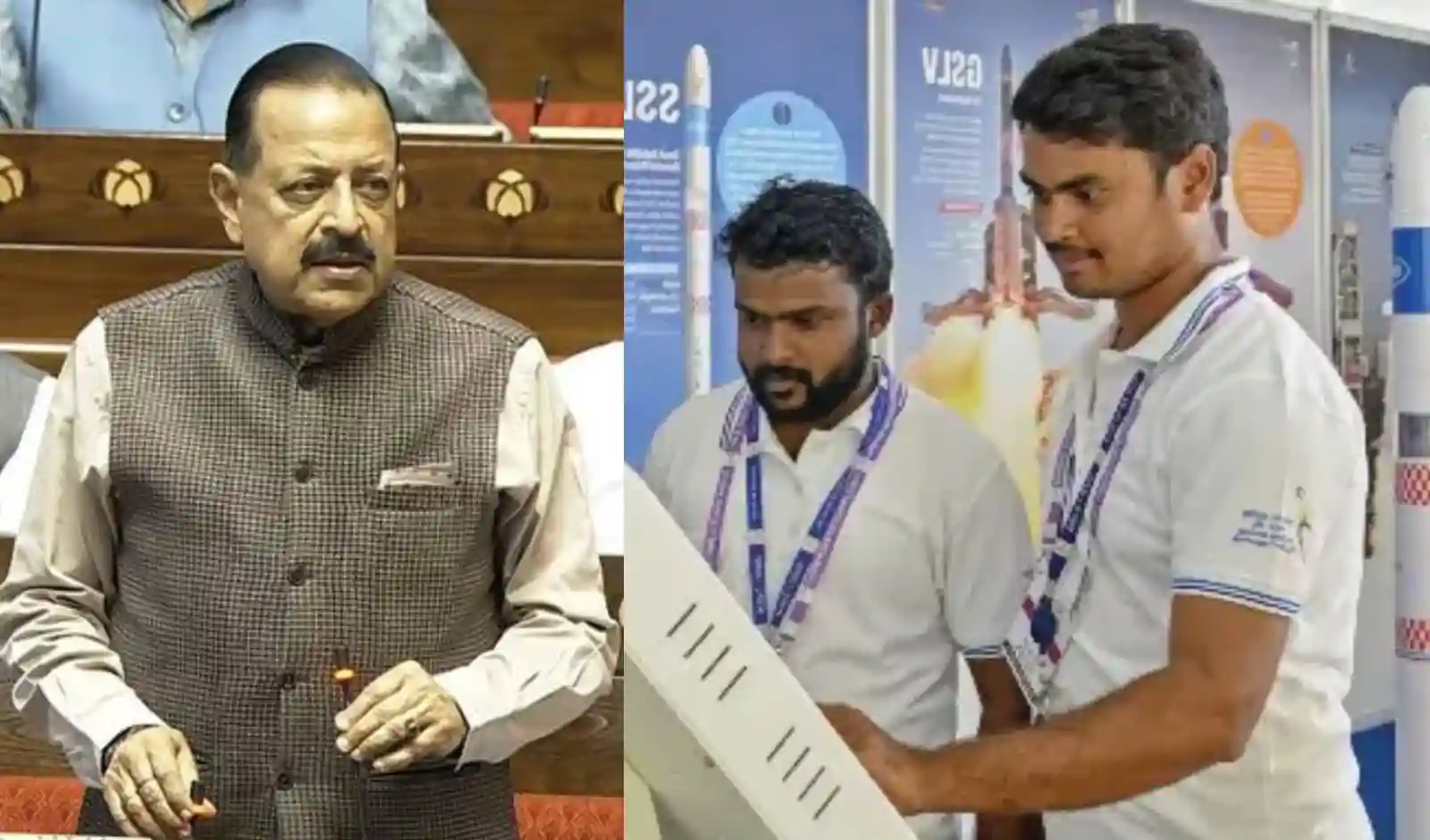
Student participation in India’s space sector is growing rapidly, marking a positive sign for the country’s future. Recently, Union Minister of State (Independent Charge) for Science & Technology and Earth Sciences, Dr. Jitendra Singh, informed the Rajya Sabha that the Indian Space Research Organisation (ISRO) is continuously taking structured steps to actively involve students and young researchers in space missions. He emphasized that today’s education is no longer limited to theory and providing practical exposure to students has become essential, which is why several initiatives have been launched in this direction.
The Minister stated that ISRO has introduced special programs under which students get opportunities to design satellites, develop payloads and work on real space technology projects. Under the student satellite program led by the U R Rao Satellite Centre, students from colleges and universities are building their own satellites with technical guidance from ISRO scientists. Notably, these student-built satellites are also provided opportunities for integration and launch through ISRO missions, helping boost both confidence and hands-on experience among students.
In addition, internship and project training schemes are being offered to students. Undergraduate, postgraduate and doctoral students from recognized institutions across the country can gain research experience at various ISRO centers. These programs allow young researchers to work directly with advanced space technologies, enabling them to contribute more effectively to the sector in the future.
To further strengthen education and research, Space Technology Incubation Centres (STICs) have been established in different parts of the country. These centers promote collaborative research between universities and ISRO scientists and support students in developing indigenous space technologies. As a result, students not only gain knowledge but also move forward in the direction of innovation.
The Minister also highlighted the role of IN-SPACe (Indian National Space Promotion and Authorization Center) in encouraging student participation. He noted that IN-SPACe organizes various student competitions focused on designing CanSats and model rockets. These competitions attract hundreds of students from across the country, significantly increasing their interest in space science. In a recent competition, around 850 students across 97 teams participated, reflecting the growing enthusiasm in this field.
He further informed that IN-SPACe has authorized 17 student satellites and payloads so far, out of which 11 have been successfully launched. These missions have seen participation from several prominent institutions, including the Indian Institute of Astrophysics, Indian Institute of Space Science and Technology, RV College of Engineering, Amity University Maharashtra, MIT World Peace University, Assam Don Bosco University, CV Raman Global University and many others. This clearly shows that not only major cities but institutions across the country are actively contributing to student-led space missions.
To make space education more inclusive, the government has also established Regional Academic Centres for Space (RAC-S). These centers act as outreach hubs to connect students from smaller cities and colleges with space science and technology, ensuring wider access to opportunities. Additionally, ISRO’s RESPOND (Sponsored Research) program provides financial and technical support to universities and academic institutions to promote research in space science, technology and applications.
In another key development, AICTE has approved short-term courses in space technology. Alongside this, under the Indian Space Policy 2023, a national-level committee has been formed to further strengthen space education in the country. The aim is to ensure that India develops a strong pool of skilled and trained youth who can take the space sector to new heights in the coming years.
The growing enthusiasm among students was also evident during the Model Rocketry and CanSat India student competition held in October 2025 in Kushinagar, Uttar Pradesh. Organized jointly by IN-SPACe, ISRO and the Astronautical Society of India (ASI), the event saw participation from around 500 students across 67 teams. These teams successfully designed, built and launched model rockets carrying CanSat payloads to an altitude of approximately one kilometer, showcasing their technical capabilities and innovation.
The government is also consistently investing in this domain. According to the Minister, around ₹10 crore is allocated annually for student-centric space education activities. Furthermore, through IN-SPACe initiatives, students and startups are being provided mentorship, pre-incubation support and co-working facilities at technical centers, enabling them to transform their ideas into real-world projects.
Overall, these initiatives represent significant steps toward building a strong and inclusive space ecosystem in India. Today, students are no longer confined to classrooms but are actively participating in real space missions. This not only benefits their individual careers but also strengthens India’s position in the global space sector.
Looking ahead, it is expected that even more students will join this field and contribute to shaping India’s identity in space science and technology. This transformation clearly indicates that the country’s future is in safe hands, driven by a young generation equipped with new ideas, advanced technology and growing enthusiasm.


