


 150
/
4
Min Read
150
/
4
Min Read


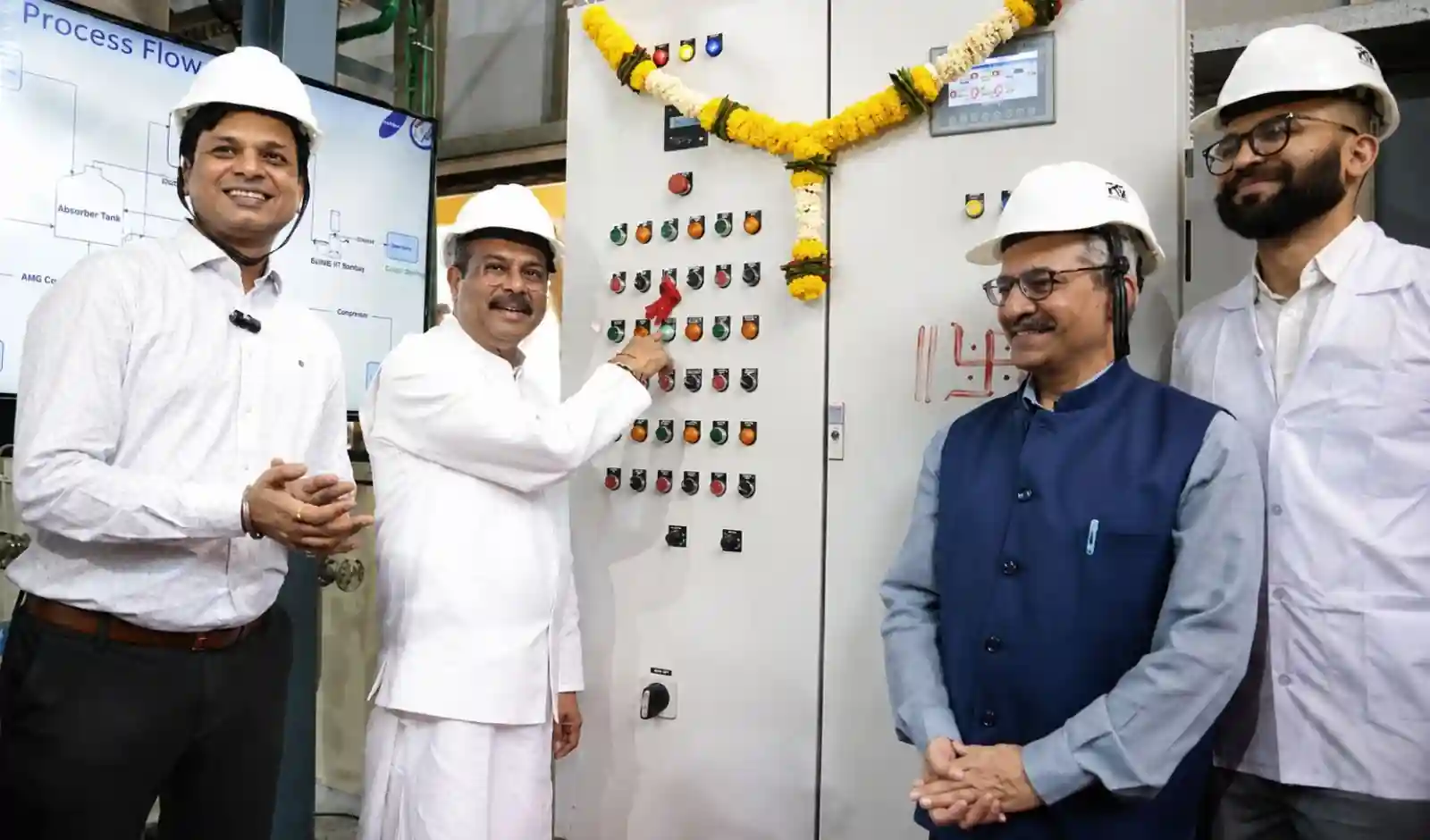
India has taken a major step toward advancing clean energy, climate technology, and research-driven education. Union Education Minister Dharmendra Pradhan inaugurated the country’s first integrated CCUS (Carbon Capture, Utilisation and Storage) field laboratory facility at IIT Bombay during the “Bharat Innovates 2026” event. This advanced facility is expected to open new research opportunities for students, researchers, scientists and industry professionals.
The event was attended by Higher Education Secretary Vineet Joshi, IIT Bombay Director Shirish Kedare, Prof. Milind Atre, Prof. Ravindra Gudi, scientists, faculty members, researchers, industry representatives, startup founders and a large number of students.
A New Direction for Clean Energy and Research
Addressing the gathering, Dharmendra Pradhan described the laboratory as a historic initiative in strengthening innovation related to clean energy and climate technology in India. He stated that the facility developed by IIT Bombay is not just a research laboratory, but a national centre for the development of future sustainable technologies.
He also appreciated “Urjanovasi,” a startup incubated at IIT Bombay’s SINE (Society for Innovation and Entrepreneurship), for playing a key role in scaling the technology. The minister said the project demonstrates that India is no longer merely a consumer of technology but is also capable of leading emerging technologies at the global level.
Students to Gain Access to Advanced Research Opportunities
Experts believe that this facility will prove highly beneficial for students and young researchers. It will provide opportunities to conduct advanced research in areas such as carbon capture technology, climate science, geology, chemical engineering and environmental science.
According to education experts, the National Education Policy (NEP 2020) emphasizes research and innovation-based learning. In this context, the establishment of world-class laboratories at institutions like IIT Bombay will provide students with global-standard technical education and practical exposure.
What is CCUS Technology?
CCUS, or Carbon Capture, Utilisation and Storage, is a technology through which carbon dioxide (CO₂) emitted from the atmosphere or industrial units is captured. The captured gas is then either utilised in industrial products or safely stored underground to reduce pollution and global warming.
This technology is considered important for helping India achieve its “net-zero emissions” target. It is also seen as a significant step toward fulfilling the “Panchamrit” climate commitments announced by Prime Minister Narendra Modi and achieving net-zero emissions by 2070.
Advanced System Developed Using Indigenous Technology
One of the biggest highlights of this project is its indigenous technology. The advanced aqueous-based carbon capture system developed at IIT Bombay is capable of capturing carbon dioxide from the atmosphere as well as industrial emissions.
The technology uses non-potable water sources such as seawater and industrial wastewater, helping reduce water wastage. The captured CO₂ is converted into high-purity carbonate and bicarbonate salts, which can be used in industries such as steel, cement, petrochemicals, and pharmaceuticals. Experts consider it a strong example of the “Waste to Wealth” model.
Scientific Drilling to Begin in the Deccan Traps
An important component of the project is Geological Carbon Sequestration. Under this initiative, scientific drilling will be carried out in the Deccan Trap region to study how carbon dioxide can be safely stored within basalt rock formations for long periods.
Scientists believe this process can convert carbon into stable minerals, significantly reducing the risk of gas leakage back into the atmosphere.
Strengthening the Link Between Research and Industry
Higher Education Secretary Vineet Joshi said that IIT Bombay’s initiative is an excellent example of collaboration between academia, industry and policymakers. He stated that the project demonstrates how research-driven technologies can be applied in industries to solve real-world challenges.
He also added that the initiative would inspire other educational institutions across the country and support India’s goal of becoming a “Developed India” by 2047.
India Could Gain Global Recognition
Climate technology experts believe that this facility could help India gain global recognition in the fields of carbon management and climate technology. It is expected to promote advanced research while strengthening collaboration among startups, industries and scientific institutions.
Experts also point out that carbon capture and climate technology are likely to become some of the world’s largest research and employment sectors in the future. In this context, IIT Bombay’s initiative is expected to play an important role in preparing Indian students and scientists for future technologies.
Why is This Initiative Important for Education and Innovation?
Education analysts believe that this project is not limited to environmental protection alone, but will also strengthen research-driven education, startup culture and technological self-reliance in India.
The initiative will provide students with opportunities to work in globally advanced laboratories, connect research with industry applications and help India move rapidly toward becoming self-reliant in climate technology.


