


 38
/
2
Min Read
38
/
2
Min Read


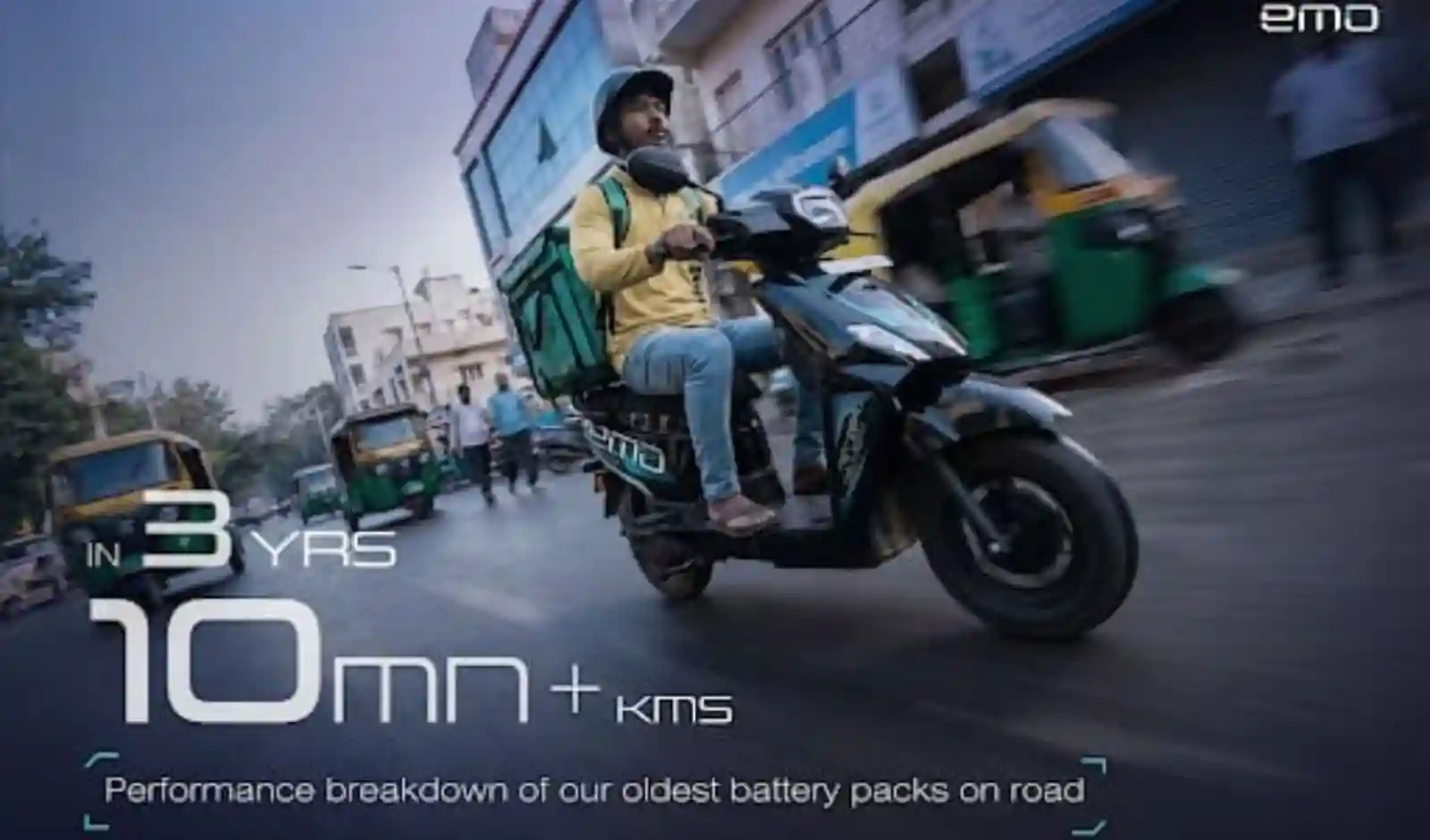
EMO Energy has developed and deployed high-utilization battery systems for electric delivery fleets over the past four years. These batteries have been powering vehicles in cities like Bangalore and Gurgaon for nearly three years, operating under demanding conditions with daily distances of up to 100 kilometers and multiple short fast-charging sessions.
Some battery packs have now crossed 75,000 kilometers, mostly powered through frequent fast charging. This performance data is captured through EMO’s SENS platform, which predicts and optimizes battery health. The insights reveal that fleet battery performance depends not only on chemistry but also on daily usage, charging patterns, temperature, and aging behavior.
Analyzing battery performance, EMO reports that after 20,000 km, the State of Health (SOH) remains around 96–98%, after 50,000 km around 90–92%, and even after 75,000 km it retains 85–88%. Compared to conventional fast-charged EV batteries, which often drop to 70–75% SOH at similar distances, EMO batteries show only 15% degradation, demonstrating better predictability and control over performance and lifespan.
The SENS platform analyzes voltage, charge–discharge patterns, temperature, and usage data to forecast degradation trajectories, detect anomalies early, optimize charging profiles, and maintain performance consistency across fleets. This predictive layer ensures batteries are not just monitored but actively managed for longevity and reliability.
“What the last four years have shown us is that battery performance in fleets isn’t about chemistry alone. It’s about how the battery is used every day - how it’s charged, how it handles heat, how it ages over time. Once you see that, you realise you have to build across all of it.” Sheetanshu Tyagi, CEO, EMO Energy
Thermal architecture also plays a crucial role. EMO batteries feature a patented immersion cooling system that maintains cell temperatures between 24–28°C. This prevents accelerated degradation and thermal runaway, even under extreme heat and frequent fast charging, ensuring long-term stability and safety.
For quick commerce fleets running 80–120 km daily with multiple fast-charging sessions, EMO’s data demonstrates that batteries remain reliable even under heavy usage. The future of electric mobility, EMO emphasizes, will depend not just on vehicles or charging networks but on intelligent energy systems built around batteries. The combination of SENS predictive intelligence and advanced thermal design ensures fleet batteries remain stable, predictable, and scalable over time.


