



 160
/
3
Min Read
160
/
3
Min Read


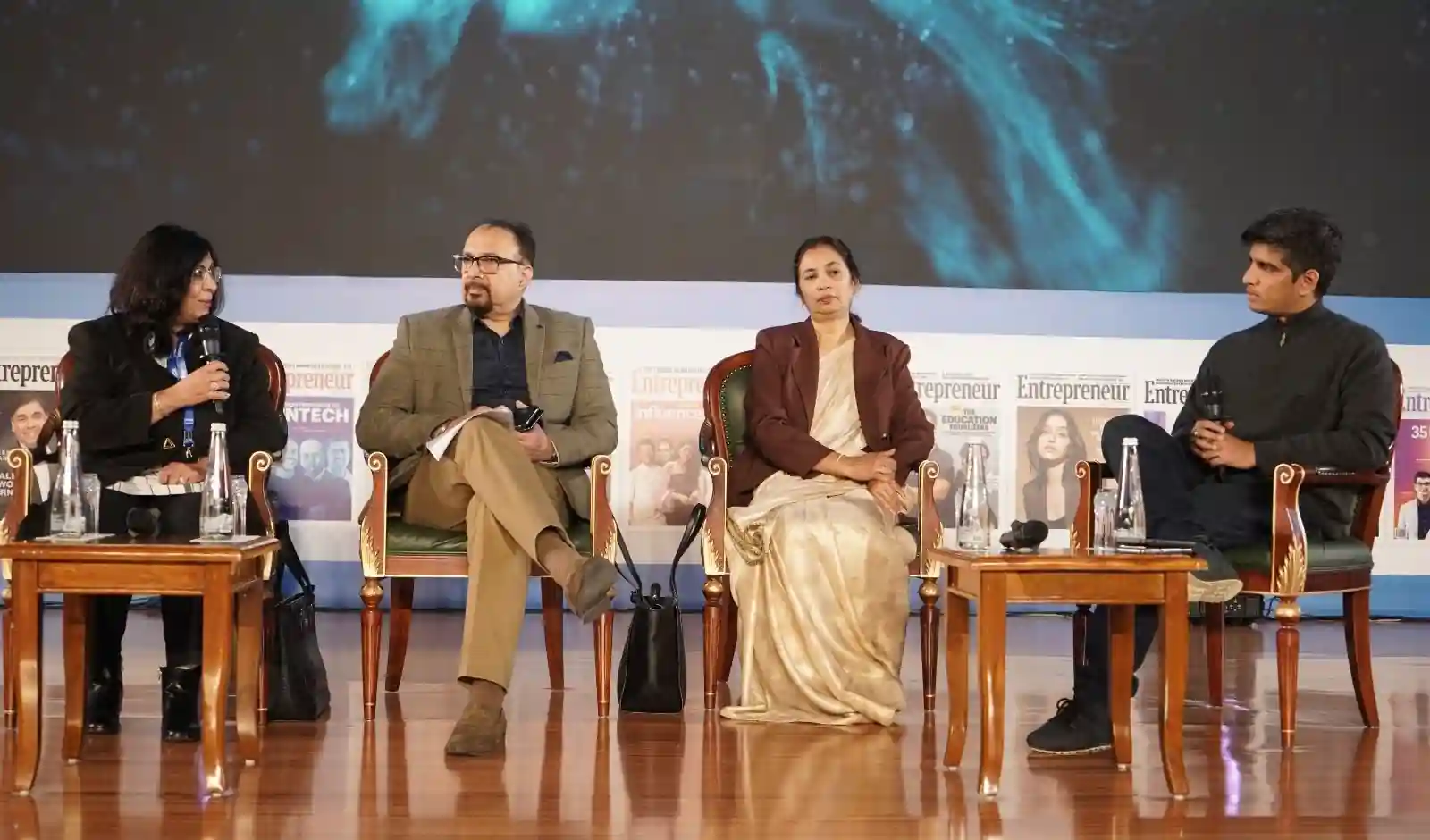
Under the theme “Beyond Degrees: EdTech for Skills, Employability & the Future Workforce,” the session conveyed a clear message that earning a degree alone is no longer sufficient. Preparing students for real-world challenges has become the most pressing need of the hour.
The panel discussion featured prominent speakers including Dr. Vini Johri from Microsoft Elevate, Dr. Chandradeep Tandon, Additional Pro Vice-Chancellor at Amity University, Febin MF, Head of L&T EdTech and Mukul Rustagi, Co-founder and CEO of Classplus. All the speakers shared insights based on their experiences, highlighting the growing gap between education and industry, the rapid pace of technological change and the increasing importance of skill-based learning.
Initiating the discussion, Dr. Vini Johri highlighted that technologies such as Artificial Intelligence, cloud computing and data analytics have brought transformative changes in both education and industry over the past few years. She pointed out that the rapid pace of technological advancement poses a challenge for the education system, as curricula and teaching methodologies are not evolving at the same speed. She emphasized that upskilling teachers and connecting them with emerging technologies is essential to make students industry-ready.
She further explained that AI is enabling personalized learning, allowing students to learn at their own pace and according to their abilities. Additionally, it is making education more inclusive by breaking barriers related to language, location and physical limitations.
Dr. Chandradeep Tandon described the widening gap between education and employment as a serious concern. He stated that industry expectations are evolving rapidly, while the education system is struggling to keep pace. He noted that earlier, research was limited to publications, but now it must be linked to patents, innovation and startups. He also stressed that universities must regularly update their curricula and ensure active industry participation so that students can become job-ready.
Febin MF emphasized that technical knowledge alone is no longer sufficient. He said that students must also develop problem-solving abilities and the right mindset. “The industry faces new challenges every day, and we need young professionals who can find solutions rather than step back,” he said. He highlighted the importance of a “solution-oriented mindset” and an “ethical approach,” adding that responsible use of technology is just as important as learning it.
The panel also underscored that Artificial Intelligence will deeply impact every sector in the coming years. Whether in education, healthcare, manufacturing or finance, AI will act as a key driver of change. Experts noted that AI is enabling content translation into multiple languages, making education accessible for differently-abled students and creating personalized learning experiences.
The discussion also highlighted the importance of strong collaboration between industry and academia. Speakers pointed out that when educational institutions and industries work together, students gain better training and real-world exposure. Many institutions are already involving industry experts in curriculum design and promoting skill-based learning.
Mukul Rustagi from Classplus stated that skilling is a continuous process that does not end with school or college but continues throughout one’s career. He emphasized that digital platforms and edtech companies are making this process more accessible and effective.
In conclusion, all experts agreed that the future workforce will not be defined solely by degrees, but by skills, adaptability and the effective use of technology. They stressed that the education system must become more flexible, practical and industry-oriented to prepare students for a rapidly changing world and enable them to compete at a global level.


