


 217
/
3
Min Read
217
/
3
Min Read


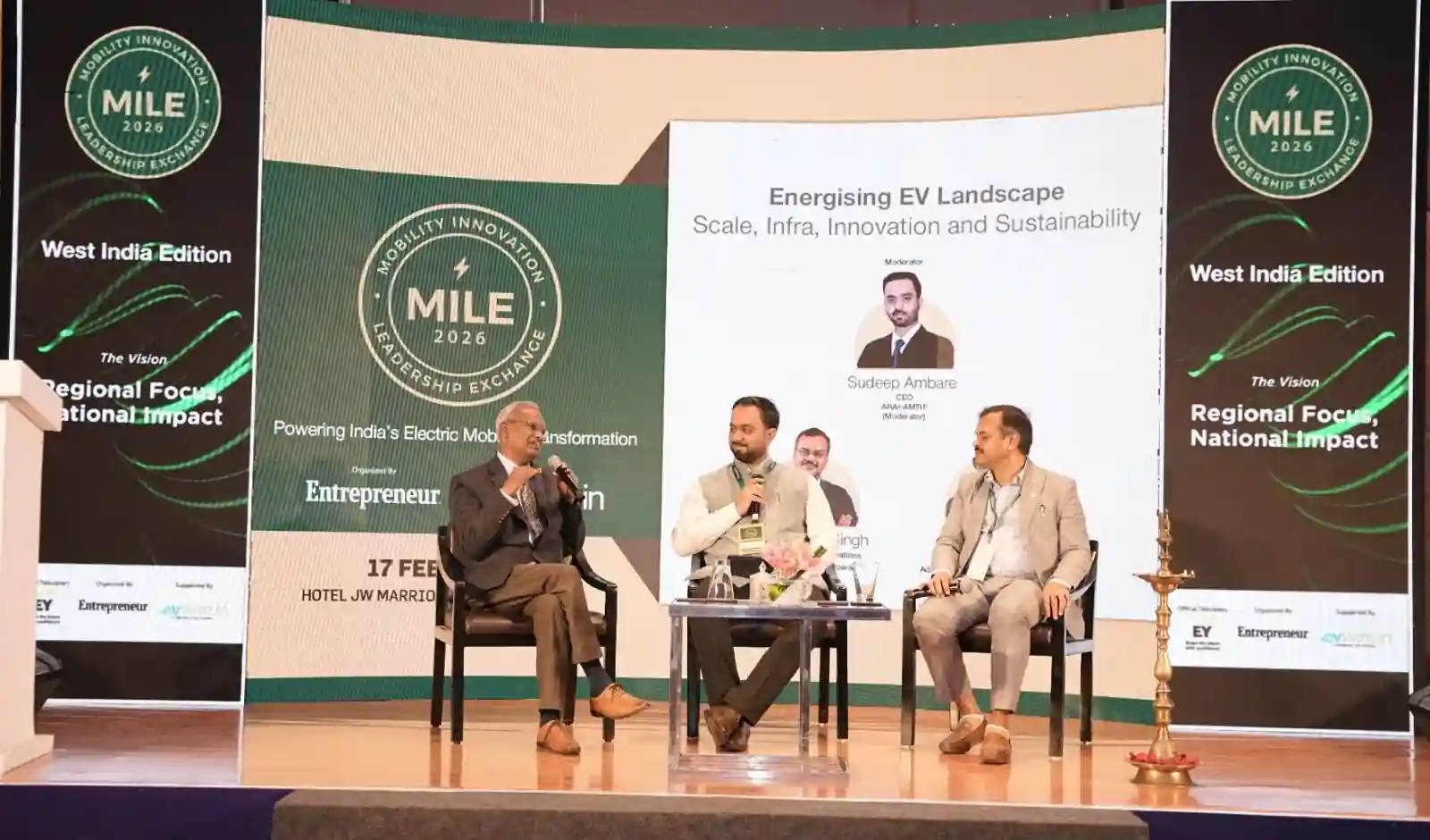
A significant panel discussion on the future of the e-mobility sector brought together industry leaders to share insights on the progress, challenges, and opportunities shaping India’s EV ecosystem. The session was moderated by Sudeep Ambare, CEO of ARAI-AMTIF. The discussion featured Ramkrishna Singh, Head of Business Operations – EV Charging at Tata Power, and Gerald Wilson, Director at Adani TotalEnergies E-Mobility Limited.
Customer Demand: The Core Driver of the EV Ecosystem
Opening the discussion, the moderator emphasized the importance of innovation, infrastructure, and collaborative growth models in accelerating e-mobility adoption. Responding to this, Ramkrishna Singh highlighted that the strongest driving force behind the EV industry is customer demand. As consumers increasingly adopt electric options across vehicle segments, charging infrastructure and services are expanding rapidly.
He noted that India has witnessed exponential growth in home charger installations, public charging networks, and bus charging infrastructure over the past few years. The sharp rise in charging sessions also reflects the growing maturity of the EV market.
Technology, Policy, and Economics: A Combined Impact
Gerald Wilson explained that EV growth cannot be attributed to customer demand alone. Technological innovation, cost reduction, and supportive government policies play equally vital roles. Advancements in battery technology, power electronics, and charging systems are steadily reducing costs and accelerating adoption.
He emphasized that government initiatives and incentives have been crucial in the early stages of industry development. According to him, the EV ecosystem is evolving through the combined efforts of customers, industry stakeholders, and policy support.
The Challenge of Balancing Demand and Supply
Discussing the expansion of charging infrastructure, Ramkrishna Singh stated that India is set to witness large-scale growth in charging networks in the coming years. He described EV adoption not merely as a shift in vehicle technology but as a broader energy transition, where renewable energy and battery storage will play a critical role.
He also pointed out that EV adoption in the four-wheeler segment remains at an early stage, while two- and three-wheeler segments are advancing rapidly.
Business Models and Grid Constraints
Addressing the commercial viability of charging infrastructure, Gerald Wilson stressed that successful business models depend on a robust power grid, sufficient vehicle density, and high utilization rates. In many regions, grid instability, high capital investment, and low utilization levels present significant challenges.
He underscored the need for indigenous technological solutions tailored to Indian conditions to enhance the reliability and sustainability of charging networks.
User Behaviour and Awareness: A Critical Factor
The panel also highlighted user behaviour as a crucial element in ecosystem development. Experts emphasized that awareness regarding safe and responsible use of charging infrastructure is essential. Misuse of equipment, limited technical understanding, and operational challenges continue to pose real barriers to industry growth.
Conclusion
India’s EV ecosystem is evolving at a rapid pace. However, its sustainable expansion will require a balanced integration of customer awareness, robust infrastructure, technological innovation, and policy support. Industry leaders expressed confidence that through collaborative efforts and long-term strategic planning, India will make decisive progress toward clean and sustainable mobility.


