


 118
/
8
Min Read
118
/
8
Min Read


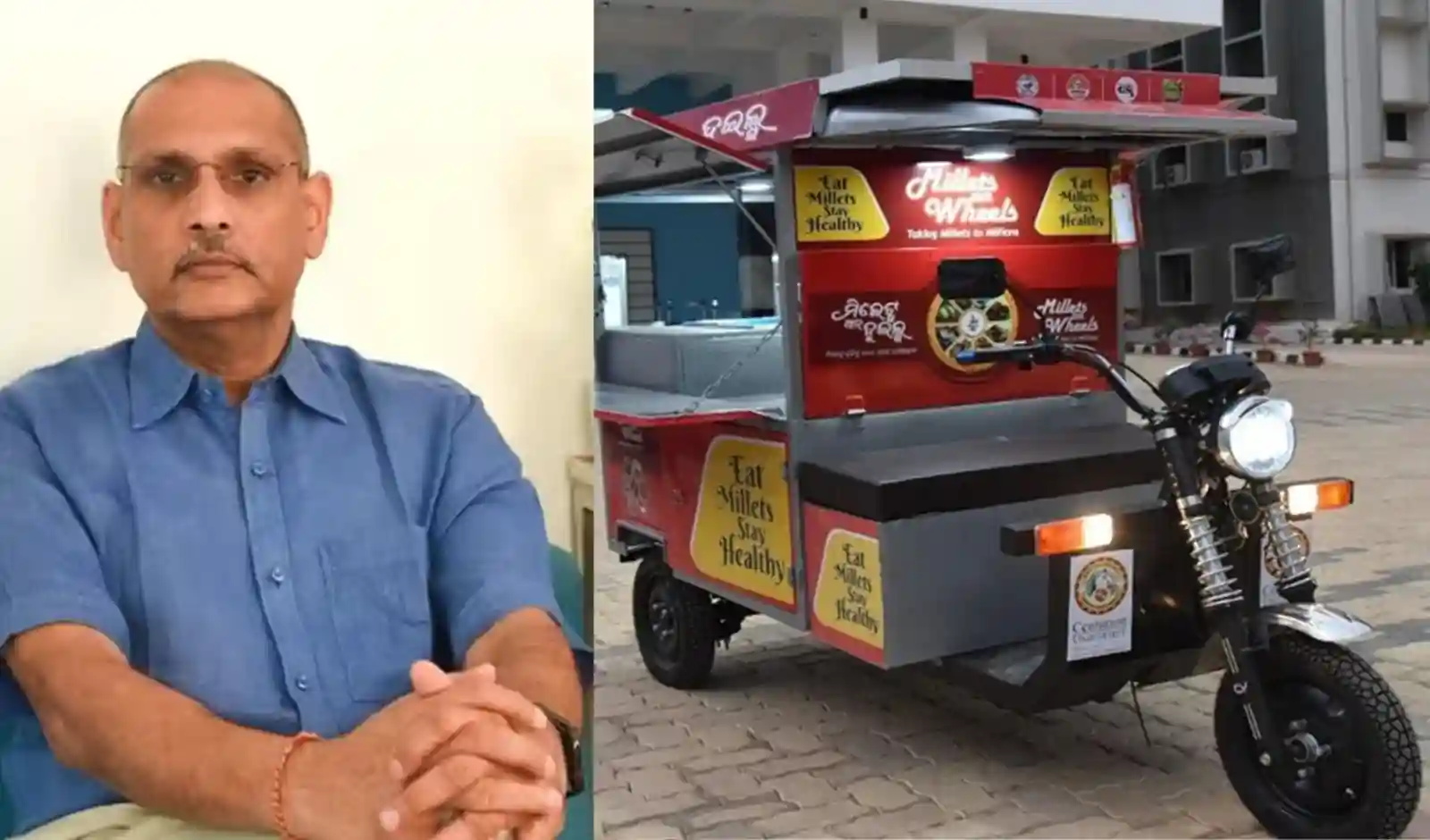
As India accelerates its transition towards electric mobility and sustainable transportation, Centurion University of Technology and Management has emerged as a unique example of how education and industry can work together to build a future-ready ecosystem. By integrating EV manufacturing, hands-on learning, and industry collaboration into academics, the university is giving students direct exposure to real-world production systems rather than limiting them to theoretical education.
In this interview, Dr. Mukti Kanta Mishra shares insights into the university’s EV journey, its transition from a skill-development initiative to a ₹25 crore manufacturing ecosystem, and how students are actively contributing to innovation, product development, and sustainable mobility solutions in India.
What inspired Centurion University to enter the electric mobility space at such an early stage, especially from an academic ecosystem?
Dr. Mukti Kanta Mishra : Centurion university was already working around the philosophy that students will have better outcomes by interacting with real systems and not being confined to theoretical concepts presented in books only. With the increased significance of electrical mobility in the manufacturing and sustainability sectors, there came the need to include such areas within the educational framework. It was less about entering a trend and more about creating practical exposure around technologies that students were eventually going to encounter outside campus anyway.
Did the EV initiative begin purely as a skill-development experiment, or did you always envision it as a scalable business model?
Dr. Mukti Kanta Mishra : What started initially as a skill-development initiative soon evolved into something much larger. At Centurion University, our primary objective was to create a hands-on learning ecosystem where students could work on real-world technologies instead of only studying theory in classrooms. The EV initiative was born from this vision to empower students with future-ready skills in electric mobility, manufacturing, design, and sustainability.
However, as the project progressed, we realized that the innovation, quality, and practical applicability of the products had strong market potential. That is when the initiative gradually transformed from a purely educational experiment into a scalable and sustainable business model. Today, it represents a unique blend of education, innovation, livelihood generation, and entrepreneurship. We are not only training students but also creating employment opportunities, supporting local manufacturing, and contributing to India’s growing EV ecosystem. The larger vision has always been to build a model where education directly connects with industry and nation-building.
The EV Manufacturing Unit has grown into a ₹25 crore success; what were the key turning points that made this transition possible?
Dr. Mukti Kanta Mishra : One of the major breakthroughs included the establishment of an industrial-based ecosystem within the university itself wherein students got hands-on experience working with manufacturing units and actual logistics chains. Another important factor was the emphasis laid by the university on practical education, entrepreneurship, peer-to-peer learning via alumni-based units, and knowledge of actual market dynamics, right from ideation to manufacturing and distribution.
How is your EV production ecosystem structured from design and prototyping to assembly and deployment?
Dr. Mukti Kanta Mishra : The structure has been built around Action Learning Labs, Production Centres, and manufacturing units where students work on EV-related projects through different stages of the process. At the university level, the exposure is not restricted to prototyping or design alone, as students also engage with manufacturing, assembly, marketing, and sales activities. The idea has been to make learning happen within environments that resemble real industrial systems.
What differentiates Centurion’s EV manufacturing model from traditional OEMs and emerging EV startups?
Dr. Mukti Kanta Mishra: One thing that stands out in the university’s approach is how closely manufacturing and education are connected. Students are introduced to production environments and industry-linked systems while they are still studying, which changes the nature of the learning experience considerably. At Centurion University, practical exposure is not treated as an additional layer after academics but as part of academics itself.
With students directly involved in building vehicles, how do you ensure industry-grade quality, safety, and reliability?
Dr. Mukti Kanta Mishra: At Centurion University, student involvement in building electric vehicles is not a classroom simulation — it is a structured industry-integrated learning ecosystem. We ensure industry-grade quality, safety, and reliability through a rigorous combination of hands-on training, expert supervision, process-based manufacturing, and continuous testing protocols. Students work alongside experienced faculty members, engineers, and industry professionals in our EV manufacturing units and specialized laboratories, where every stage from chassis assembly and powertrain design to battery management and operational testing follows defined quality standards and safety procedures.
Our model focuses on ‘learning by doing’ while adhering to real-world industrial practices. Students are trained in component selection, inspection, troubleshooting, operational testing, and workplace safety before they participate in live manufacturing projects. We also utilize advanced design and simulation platforms and collaborate with industry stakeholders to ensure our EVs meet practical market requirements. What makes Centurion unique is that students are not merely learning technology; they are contributing to commercially relevant innovation under a highly monitored and outcome-driven ecosystem.
Have there been any standout student-led innovations that significantly improved product performance or reduced costs?
Dr. Mukti Kanta Mishra: Yes, several student-led innovations at Centurion University have helped improve vehicle efficiency and reduce production costs. Our students have worked on optimizing EV powertrains, lightweight vehicle design, battery integration, and troubleshooting systems, making the vehicles more economical and practical for real-world use. What is most encouraging is that many of these innovations emerged from hands-on learning inside our EV manufacturing ecosystem, where students directly contribute to product development and process improvement.
What core technologies are you developing in-house especially in areas like battery systems, drivetrain, or vehicle design?
Dr. Mukti Kanta Mishra: Centurion university has been working in areas connected with battery technology, EV systems, charging infrastructure, and sustainable mobility. In addition, there has been an effort to develop battery manufacturing technology in India as part of India’s expanding clean transport ecosystem.
How do you sustain R&D continuity in a university environment where students graduate and new cohorts take over?
Dr. Mukti Kanta Mishra: At Centurion University, it is the ecosystem that brings about continuity, not just individual efforts. Action Learning Labs, Production Centers, internships, and manufacturing units run by the university's alumni are responsible for maintaining students' links through continuous practice. Consequently, technical knowledge and experiential learning continue to flow smoothly between batches.
Your EVs are positioned as affordable solutions; how do you balance cost efficiency with durability and performance?
Dr. Mukti Kanta Mishra : The university’s larger effort has been towards building economically designed EV solutions while continuing to focus on practical engineering exposure and skill-based learning. Alongside affordability, Centurion University has also kept its attention on sustainable and accessible mobility solutions that align with the changing needs of India’s EV ecosystem.
What is your long-term vision for Centurion University in India’s EV and green mobility ecosystem and what’s the next big leap?
Dr. Mukti Kanta Mishra : The long-term vision is closely tied to India’s larger clean mobility transition. Centurion University aims to make its contribution in the form of sustainable innovations, battery technologies, entrepreneurship, industrial cooperation, and skills-based education. Training the students for the opportunities that will emerge in the electric vehicle industry will be another aspect of it.
Could you share the key clients or organizations from whom you receive orders that students help fulfill?
Dr. Mukti Kanta Mishra : Government of Odisha, OMFED, Tata Group, OMC, Apollo Hospitals, NTPC Limited, OCAC, SMS Group, Punjab National Bank, Jindal Stainless Limited, SUM Hospital, State Bank of India, Assotech, Swosti Group, ORMAS, Quess Corp, Tata Steel, Tata Technologies, Institute of Minerals and Materials Technology and Bharat Electronics Limited are among the key organisations and industry partners from whom we receive orders and collaborative projects that students actively help execute. These engagements span sectors such as manufacturing, healthcare, mining, banking, technology, hospitality, infrastructure and government initiatives, giving students valuable hands-on industry exposure while working on real-world assignments and production-oriented projects.
What types of products do students manufacture as part of their learning process?
Dr. Mukti Kanta Mishra: Students work on projects related to electric vehicles in terms of system design, component design, production line setup, and manufacturing process. We make E Rickshaw, Golf Cart, Utility Carts & E Bus. This initiative aims to make the students acquainted with industrial settings by actually working rather than being taught theoretically.
Conclusion
Centurion University’s EV manufacturing model highlights how education can move beyond classrooms to become a driver of innovation, entrepreneurship, and industrial growth. By combining practical learning with real manufacturing exposure, the university has created an ecosystem where students not only gain technical knowledge but also contribute to commercially relevant EV solutions.
As India EV and green mobility sector continues to expand, Centurion University’s approach stands out as a strong example of industry-integrated education that supports skill development, local manufacturing, and sustainable innovation. The initiative has the potential to play an important role in shaping the next generation of talent for India’s clean mobility future.


