



 283
/
11
Min Read
283
/
11
Min Read


Every year, millions of students graduate from higher education institutions across India. Yet, despite holding academic qualifications, many struggle to secure meaningful employment due to a lack of industry-relevant skills. At a time when employability has become one of India's biggest workforce challenges, stronger collaboration between universities, industry and EdTech companies has never been more important.
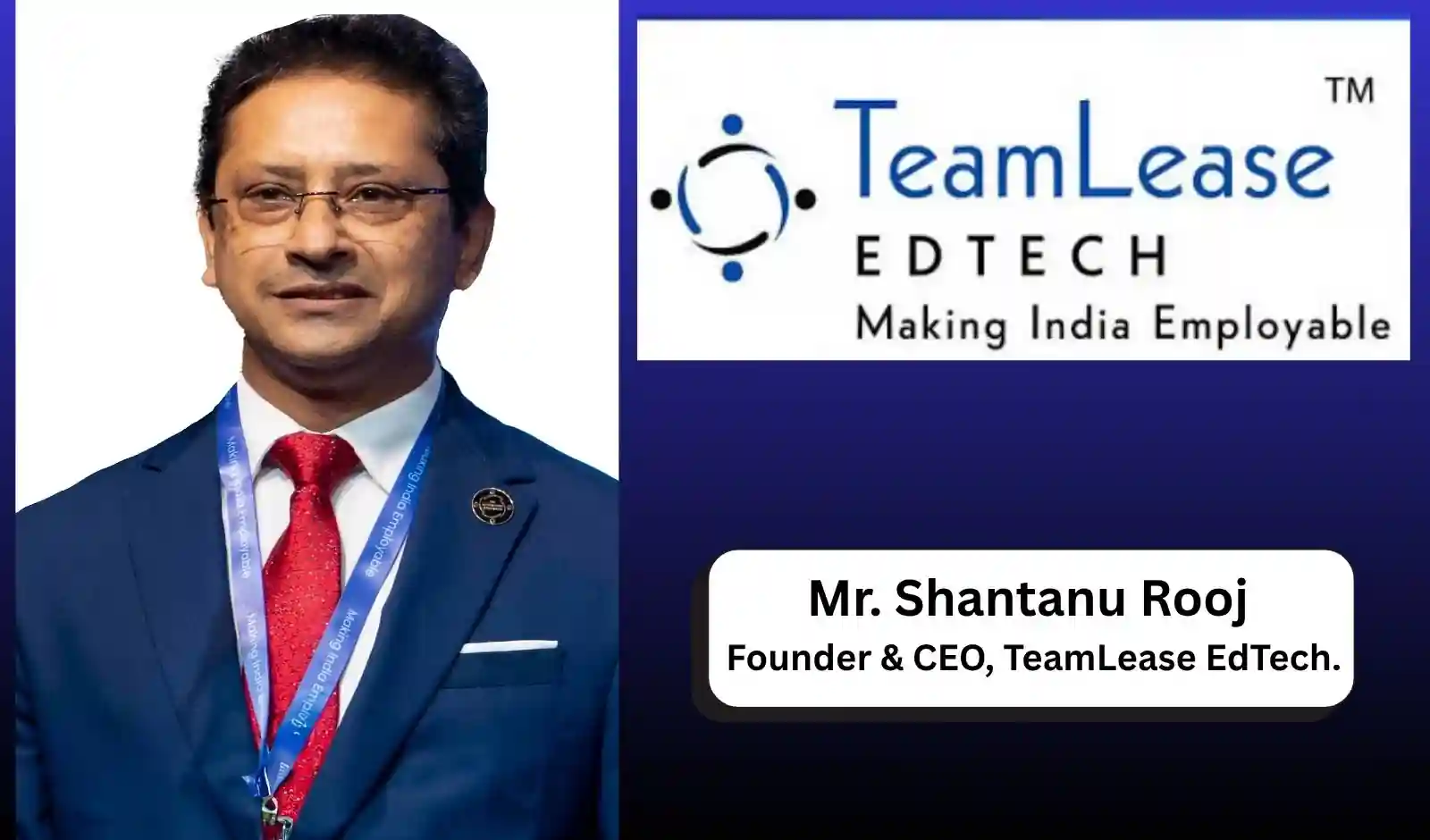
In an exclusive interaction with Entrepreneur India, Shantanu Rooj, Founder & Chief Executive Officer (CEO) of TeamLease EdTech, shares his insights on employability-driven education, online degrees, apprenticeships, Artificial Intelligence (AI), academia-industry collaboration and his vision for building a future-ready workforce for India.
1. What has been TeamLease EdTech's biggest achievement in bridging the skill gap between education and employment in India?
Shantanu Rooj: India's employability challenge cannot be addressed through a single intervention. It requires a comprehensive education-to-employment ecosystem that prepares learners for real-world careers rather than simply awarding academic degrees.
At TeamLease EdTech, our approach is built around three strategic pillars Prepare, Repair and Upgrade. We collaborate with universities to prepare students through employability-linked degree programmes, partner with employers to bridge skill gaps through workplace learning and apprenticeships and help working professionals upgrade their capabilities as industries continue to evolve.
One of our biggest achievements has been creating a model where education is no longer viewed as separate from employment. We strongly believe in a blended learning ecosystem where learners receive academic knowledge from universities, digital access through online learning and practical exposure through real workplace experiences.
This philosophy forms the foundation of our Work-Integrated Learning and Apprenticeship-Embedded Degree Programmes.
Today, through collaborations with leading universities and educational institutions, lakhs of learners on our platform, and thousands of corporate partnerships, we are creating pathways where degrees are directly connected to meaningful careers. We believe this model has the potential to redefine Indian higher education by shifting the focus from degree completion to measurable employability and career readiness.
2. What are TeamLease EdTech's key growth strategies for the next three to five years?
Shantanu Rooj: India's journey towards becoming a developed economy will largely depend on the quality, productivity and employability of its workforce over the next decade.
The country undoubtedly enjoys a strong demographic advantage. However, a demographic dividend does not automatically translate into economic growth. To fully realise this opportunity, India must make sustained investments in skilling, reskilling and continuously upgrading the capabilities of its young workforce. Our long-term growth strategy is aligned with this national opportunity.
We will continue strengthening the connection between education and employment by working closely with universities to design employability-focused academic programmes, enabling learners to access flexible and outcome-driven education and supporting employers in building sustainable talent pipelines.
Our focus will remain on expanding Work-Integrated Degree Programmes, Apprenticeship-Linked Learning Models, Online and Blended Education, Corporate Skilling and career discovery initiatives through platforms such as Digivarsity.
We also see tremendous growth opportunities in executive education and next-generation technology programmes, particularly in high-demand domains such as Artificial Intelligence (AI), Data Science, Cybersecurity, Semiconductors, FinTech, Supply Chain Management, Healthcare Technology, and Digital Business. However, our larger ambition goes beyond expanding TeamLease EdTech as an organisation.
Our vision is to help transform higher education itself making it a pathway to sustainable careers, lifelong learning and long-term employability rather than simply a means of acquiring academic qualifications.
3. How do you see online degrees and apprenticeship models transforming India's employability and workforce landscape?
Shantanu Rooj: Online education has the potential to democratise higher education in India by making quality learning more accessible, affordable, and inclusive. It enables students from smaller towns and remote regions to access programmes offered by leading universities and learn from experienced faculty without geographical limitations. However, online education alone is not enough.
While it offers flexibility and wider access, it may not always provide the practical exposure and workplace experience that students need to become job-ready. This is where apprenticeship and work-integrated learning become critical.
At TeamLease EdTech, we believe that the future of higher education lies in combining academic learning with real-world work experience. Through apprenticeship-linked and work-integrated degree programmes, students learn classroom concepts from universities while simultaneously applying that knowledge in professional work environments. This integrated approach creates a win-win situation for all stakeholders.
Students gain valuable workplace exposure, develop professional discipline, understand industry expectations, and become productive much earlier in their careers. Employers benefit by hiring candidates who already possess practical experience, reducing training time and improving workforce productivity.
Most importantly, education evolves from being merely a qualification into a meaningful career pathway. We firmly believe that the future of employability will not be shaped by degrees alone, but by degrees that are closely connected to real work, practical learning, and industry experience.
4. What new initiatives is TeamLease EdTech undertaking to prepare students for careers in the age of Artificial Intelligence (AI) and emerging technologies?
Shantanu Rooj: Artificial Intelligence and emerging technologies are transforming not only the way industries operate but also how students learn and build their careers. Our objective is not simply to introduce students to these technologies in the classroom. We want them to understand how AI and digital technologies can be applied to solve real business challenges and create measurable value across industries.
To achieve this, TeamLease EdTech is working closely with leading universities, IITs, IIITs, IIMs and other premier institutions to offer specialised programmes in high-growth domains such as Artificial Intelligence, Machine Learning, Data Science, Cybersecurity, FinTech, Healthcare Technology, Internet of Things (IoT), Semiconductors, Cloud Computing and Digital Business. At the same time, we are embedding future-ready capabilities across broader academic programmes.
AI can no longer remain confined to computer science students. Tomorrow's professionals in commerce, management, finance, healthcare, logistics, human resources and several other sectors will also require AI literacy and digital competencies to remain competitive.
Through Digivarsity and our extensive university partnerships, we are helping learners identify the right academic programmes, understand emerging career opportunities, and develop skills that align with rapidly evolving industry requirements. Our larger mission is to move beyond technology awareness and focus on technology-driven employability.
Students must understand not only what AI is, but also how it can improve decision-making, enhance productivity, strengthen customer experiences, accelerate research, optimise operations, and drive business outcomes. The professionals who will succeed in the future are those who can combine technological knowledge with critical thinking, problem-solving, adaptability, and the ability to apply innovation in real-world business environments. That is the kind of future-ready workforce TeamLease EdTech is committed to building.
5. What are your plans to further strengthen partnerships with universities, employers, and industry stakeholders?
Shantanu Rooj: Partnerships are at the heart of our business model because employability cannot be built by any single stakeholder. Universities provide academic excellence and access to learners, employers define industry requirements and workplace expectations, while platforms like TeamLease EdTech bridge the two through technology, programme management, apprenticeships, skilling and learner support.
We are witnessing growing interest from universities that are looking to redesign their academic offerings to make them more relevant to today's job market. Our execution capabilities and experience in developing scalable, compliant and employability-focused programmes have enabled us to become a trusted partner for many higher education institutions.
However, our strategy is not driven by numbers alone. We are focused on building long-term relationships with institutions that share our vision of making Indian graduates more employable and future-ready.
On the employer side, we continue to expand our partnerships across industries and geographies. Today's organisations are looking beyond academic qualifications. They want professionals who are equipped with practical skills, workplace readiness, and the ability to contribute from day one. Our role is to help organisations build structured talent pipelines through apprenticeship programmes, work-integrated learning, corporate skilling initiatives and outcome-driven education models.
Ultimately, the success of these partnerships will not be measured by the number of institutions or employers we work with, but by the career outcomes of our learners and the productivity they bring to the workforce.
6. As TeamLease EdTech continues to grow, what is your vision for expanding its global footprint and creating greater international opportunities for Indian learners?
Shantanu Rooj: At present, our primary focus remains India because the opportunities here are immense. The country still has significant work to do in expanding access to quality higher education, improving employability, strengthening apprenticeship ecosystems and enhancing workforce productivity. Our immediate mission continues to be 'Making India Employable.'
That said, Indian talent is increasingly becoming a global asset. Professionals from India are making a significant impact across technology, healthcare, financial services, analytics, digital business and several emerging sectors worldwide. Our long-term vision is to equip Indian learners with globally relevant skills, regardless of whether they build their careers in India or abroad.
As India strengthens its position as a global talent hub, we see tremendous opportunities to facilitate international collaborations, global career pathways and programmes that benchmark Indian learners against international standards. However, our approach to global expansion will remain thoughtful and disciplined.
Before establishing a significant international footprint, our priority is to build greater depth, scale and impact within India. We believe that creating a robust education-to-employment ecosystem at home will naturally position us for sustainable global growth.
Our ambition is not merely to expand internationally but to ensure that Indian learners are equipped with world-class skills that enable them to succeed in an increasingly interconnected global economy.
7. Looking back on your entrepreneurial journey, what were the biggest challenges in building TeamLease EdTech, and what leadership principles, strategic efforts, and support systems helped you overcome them?
Shantanu Rooj: Building TeamLease EdTech has been a journey of creating belief in an idea long before the market was ready to embrace it.
When we started, higher education, online learning, apprenticeships, and employability were largely viewed as independent conversations. Universities focused on academic delivery, employers concentrated on hiring, and students were expected to bridge the gap between education and employment on their own. Our biggest challenge was changing this mindset.
We believed that employability should not be treated as an outcome after graduation; it must be embedded into the education system itself. Bringing together universities, employers, learners, and policymakers around this shared vision required patience, persistence, and continuous engagement. Another significant challenge was executing this vision at scale.
Education is built on trust. Universities expect high academic quality and regulatory compliance. Employers want graduates who are genuinely work-ready. Students seek confidence that their education will translate into meaningful career opportunities.
Building that trust demanded consistency, transparency, strong execution and an unwavering commitment to learner success. One leadership principle has guided us throughout this journey clarity of purpose. Our mission of 'Making India Employable' has remained our guiding force, helping us stay focused despite market changes, technological disruptions, and operational complexities.
We have also been fortunate to build an exceptional team, establish strong institutional partnerships, nurture long-standing employer relationships, and benefit from the broader TeamLease ecosystem. Together, these have enabled us to stay learner-centric, execution-focused and outcome-driven.
Entrepreneurship in education is unlike building most other businesses. It requires balancing innovation with patience, ambition with responsibility and growth with long-term impact. For us, real transformation happens only when purpose, partnerships, perseverance, and execution come together.
Conclusion : As India stands on the cusp of becoming one of the world's largest knowledge economies, the country's higher education ecosystem must evolve beyond awarding degrees to creating employable, future-ready professionals.
In this exclusive conversation with Entrepreneur India, Shantanu Rooj underscores that the future of education lies in integrating academic learning with workplace experience, digital capabilities and industry collaboration. According to him, online education, apprenticeships, work-integrated learning, Artificial Intelligence and stronger academia-industry partnerships will play a defining role in reshaping India's employability landscape.
He believes India's greatest strength lies in its young population. However, the country's demographic advantage can only translate into sustained economic growth if young people are equipped with relevant skills, practical experience and lifelong learning capabilities.
With its vision of 'Making India Employable,' TeamLease EdTech continues to work towards building an education ecosystem where learning leads not just to degrees, but to meaningful careers, workforce readiness and long-term economic progress. As industries continue to evolve, Rooj believes that institutions capable of aligning education with employability will play the most significant role in shaping India's future workforce.


