


 134
/
4
Min Read
134
/
4
Min Read


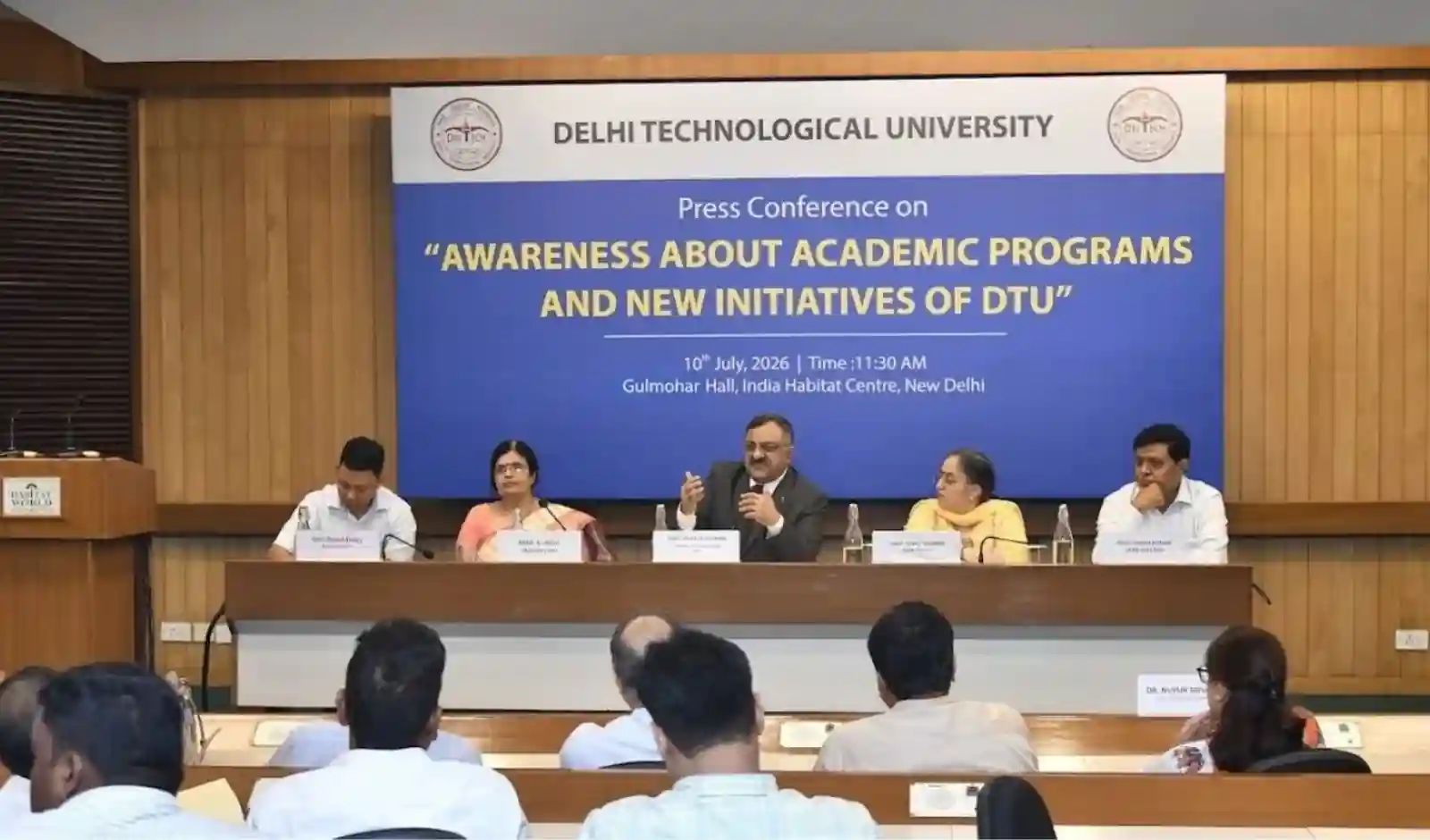
In line with the National Education Policy (NEP) 2020 and its focus on interdisciplinary and industry-oriented education, Delhi Technological University (DTU) has announced a series of new academic programmes. Speaking at the university's annual press conference held to mark 85 years of DTU, the university announced that it will introduce two new Integrated BSc-MSc programmes in Data Science and Applied Statistics from the 2026-27 academic session. These programmes are aimed at preparing students for the growing demand in data science, artificial intelligence and other emerging technology sectors.
Accelerated BTech-MS Programme with the University of Houston
DTU has also launched a 4+1 Accelerated BTech-MS Programme in collaboration with the University of Houston, USA. Under this programme, students will complete their four-year BTech degree at DTU and then pursue a one-year MS programme at the University of Houston. Eligible academic credits earned at DTU will be transferable, subject to the university's admission policies, providing students with access to global education and international research opportunities.
New BTech Programmes Planned
Looking ahead, the university has announced plans to introduce new engineering programmes aligned with future industry requirements. Mechanical and Automation Engineering will be launched from the 2026-27 academic session, while Computer Science and Engineering and Quantum Technology programmes are scheduled to begin from 2027-28. These programmes are designed to equip students with skills required for next-generation technologies and rapidly evolving industrial landscapes.
Economics Double Major for BTech Students
As part of its push toward interdisciplinary education, DTU has introduced an Economics Double Major for BTech students from the 2026-27 academic session. The curriculum includes contemporary subjects such as Network Economics, Platform Economics, Economics of AI, Game Theory, Mechanism Design, Machine Learning for Economics, and High-Frequency Algorithmic Trading. The initiative aims to help engineering students develop analytical, economic and decision-making capabilities alongside their technical expertise.
Industry-Recognised Micro-Credential Programmes Integrated into Curriculum
DTU also announced that it is among the first universities in India to integrate industry-recognised micro-credential programmes into its academic curriculum. The university has partnered with organisations including the National Institute of Solar Energy (NISE), Bureau of Energy Efficiency (BEE), ANSYS-Synopsys, Siemens, IRISET, Premas Life Sciences and the Wadhwani Foundation.
These programmes will focus on high-growth sectors such as renewable energy, semiconductor design, railway signalling, biotechnology and entrepreneurship, enabling students to gain practical, industry-relevant skills while pursuing their degrees.
New Programmes for School Students and Working Professionals
DTU has also introduced a six-week, three-credit Certificate Course in Applied AI, Data Analytics and Entrepreneurship for students from Class 9 onwards. In addition, the university has launched a Sports Analytics Programme, covering data analytics, artificial intelligence and performance analysis.
Through its Centre for Technology Enhanced Learning (CTEL), DTU has also introduced online certificate programmes for working professionals in Artificial Intelligence, Renewable and Sustainable Energy Management and CSR, ESG & Corporate Sustainability.
Aligned with NEP 2020 and the Vision of Viksit Bharat
Speaking at the event, DTU Vice Chancellor Prof. Prateek Sharma said the university's new initiatives are aligned with the objectives of NEP 2020. He noted that DTU aims to contribute to India's emergence as a global knowledge economy by promoting interdisciplinary education, research excellence, industry collaboration and entrepreneurship. He added that these initiatives also support the national visions of Atmanirbhar Bharat and Viksit Bharat 2047.
Strengthening the Research Ecosystem
The university revealed that it secured nearly 40 patents over the past year and received significant research funding from agencies including ANRF, MeitY, DRDO, ISRO and the Ministry of Science & Technology.
To further strengthen its research ecosystem, DTU has introduced several new faculty support schemes, including the Young Faculty Grant, Equipment Matching Grant, Faculty Interdisciplinary Research Project, and Multi-Institutional Faculty Interdisciplinary Research Project. The university has also introduced institutional awards to recognise excellence in sponsored research and timely completion of doctoral research.
Expanding Industry Collaboration
DTU has further strengthened its industry and institutional partnerships by signing collaborations with leading organisations, including ASSOCHAM, Esri India, the Indian Army, Defence Space Agency, Bajaj Auto Limited, GRIHA Council, Gujarat Fluorochemicals Limited, National Council for Cement and Building Materials, CSIR-NPL, IUAC, IRISET, Darshan Education Foundation, Premas Life Sciences, Navjyoti India Foundation, ANSYS-Synopsys, ICMAI and the Ministry of Statistics and Programme Implementation.
The university believes these partnerships will provide students with greater opportunities for industry-oriented training, research, innovation, internships and employment. DTU's latest initiatives represent a significant step towards aligning higher education with evolving industry needs while preparing students for the demands of the global knowledge economy.


