


 619
/
5
Min Read
619
/
5
Min Read


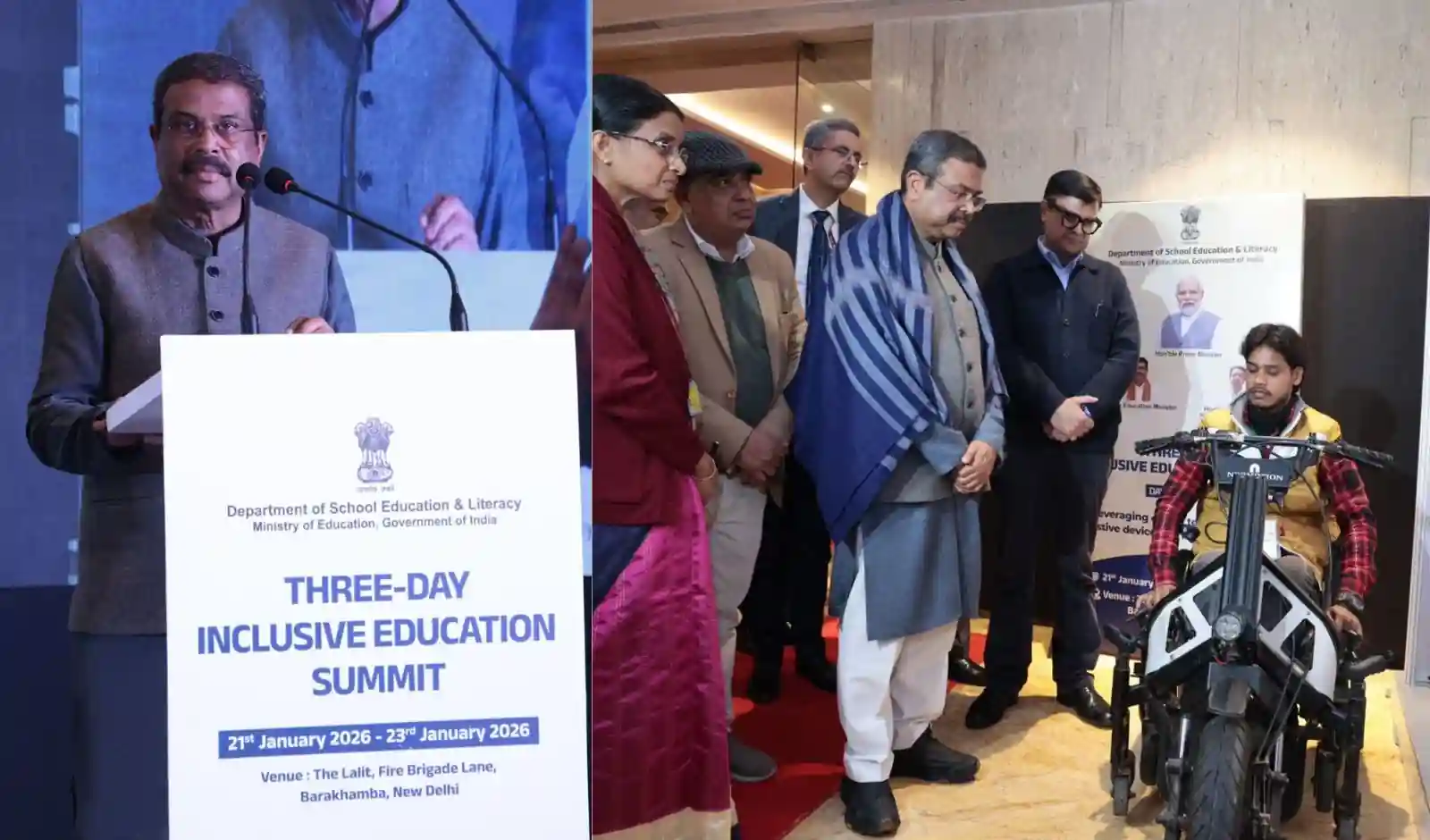
Union Education Minister Dharmendra Pradhan today inaugurated the 'Inclusive Education Summit-2026' in New Delhi, which aims to strengthen policy and practice for Inclusive Education, promote the adoption of assistive technologies and digital tools, build teacher capacity and institutional readiness, foster inter-sectoral collaboration and identify future directions for education-to-employment pathways for persons with disabilities.
Union Education Minister Shri Dharmendra Pradhan today inaugurated the three-day Inclusive Education Summit 2026, organized by the Department of School Education and Literacy (DoSEL), Ministry of Education, in New Delhi from January 21-23, 2026. He also inaugurated an exhibition showcasing the latest technology-enabled assistive devices for children with special needs (CwSN). Present on the occasion were Shri Sanjay Kumar, Secretary, DoSEL; Shri Dinesh Prasad Saklani, Director, NCERT; Dr. Mallika Nadda, Chairperson, Special Olympics India; and senior officials from the Ministry of Education, NCERT, national institutions, and other stakeholders.
During the conference, Dharmendra Pradhan stated that the Inclusive Education Summit is aimed at strengthening the national commitment to inclusive education. He emphasized that inclusive education is not limited to a single scheme, but represents a collective resolve to ensure dignity, equal opportunity and a self-reliant future for every child. Reiterating Prime Minister Narendra Modi's vision of "Sabka Saath, Sabka Vikas, Sabka Vishwas" he underlined that the foundation of a developed India can be laid through equitable, sensitive and inclusive education. He stated that the expansion of disability categories from six to twenty-one reflects this inclusive approach.
He emphasized the importance of early identification of learning challenges such as dyslexia and dyscalculia and stated that inclusive education is not solely the responsibility of schools or families, but a shared responsibility of the entire society. He further stated that this collective approach, based on equal opportunity, dignity and participation, will pave the way for achieving a developed India. The
Union Minister also visited the exhibition showcasing assistive products, solutions and smart technologies at the Inclusive Education Summit. He commended the innovative and world-class solutions developed by Indian startups to make education more inclusive and address the diverse needs of children with special needs (CWSN) and persons with disabilities (PWDs).
He emphasized that ensuring dignity, accessibility and equal opportunities for the disabled population is a collective responsibility. He also stressed the need for sustained efforts through supportive laws, accessible infrastructure, inclusive policies and continuous innovation to realize the vision of a developed India.
Speaking at the conference, Sanjay Kumar said "The National Education Policy 2020 envisages an inclusive education system that ensures no child is left out of school, and has a clear goal of achieving 100 percent gross enrolment at the secondary level by 2030. He emphasized that inclusion is more than just access and that every child entering the education system should achieve meaningful learning outcomes, feel safe, develop socially and receive support through early identification and timely intervention for any specific learning disabilities, especially during the formative years." He further said "Empathy must be developed in all children and teachers to be sensitive to the diverse needs of all."
The Inclusive Education Summit 2026, Aims
To strengthen policies, practices and innovations for inclusive education for children with special needs (CWSN) in line with the National Education Policy (NEP) 2020 and the Rights of Persons with Disabilities Act (RPwD) 2016. Envisioned as a collective platform for reflection and learning, the Summit brings together policymakers, national institutions, states and union territories, education boards, experts, civil society organizations, startups and industry partners to share best practices, showcase innovations and chart future paths for inclusive education in India.
Mrs. A. Sreeja, Economic Advisor, Department of School Education and Literacy (DoSEL), presented the background to the Summit. She explained that the Summit brings together all stakeholders to strengthen collective efforts towards building an education system that works for every child and addresses all aspects of inclusive education, from early identification and learning to participation, skills and livelihoods. It also discussed inclusive assessment and examination facilities with school boards, as well as skill development and employment opportunities for children with special needs (CwSN).
Key Focus Areas Of This Education Summit
The three-day summit will deliberate on various topics, such as the use of digital technologies and assistive devices for inclusive education and will focus on the role of digital technologies and assistive devices in improving access, participation and learning outcomes for persons with special needs (CwSN). Innovative solutions addressing visual, hearing, mobility, intellectual and multiple disabilities will be showcased through live demonstrations and exhibitions by startups, research institutions and national organizations.
Key national initiatives and capacity-building measures will also be highlighted, including: PRASHAST 2.0, an advanced disability screening and tracking tool integrated with UDISE+; teacher training and sensitization of teaching and non-teaching staff for inclusive classrooms; strengthening resource rooms and resource centers through proposed national guidelines and promoting inclusive sports and vocational education pathways for persons with disabilities.
Therefore, on the final day of the conference, future opportunities for students with specific learning disabilities will be explored, addressing issues related to curriculum adaptation, teaching methods, assessment and board-level provisions. Remedial education, skills development and education-to-employment pathways will also be discussed, with the participation of education boards and private sector stakeholders.


