


 210
/
6
Min Read
210
/
6
Min Read


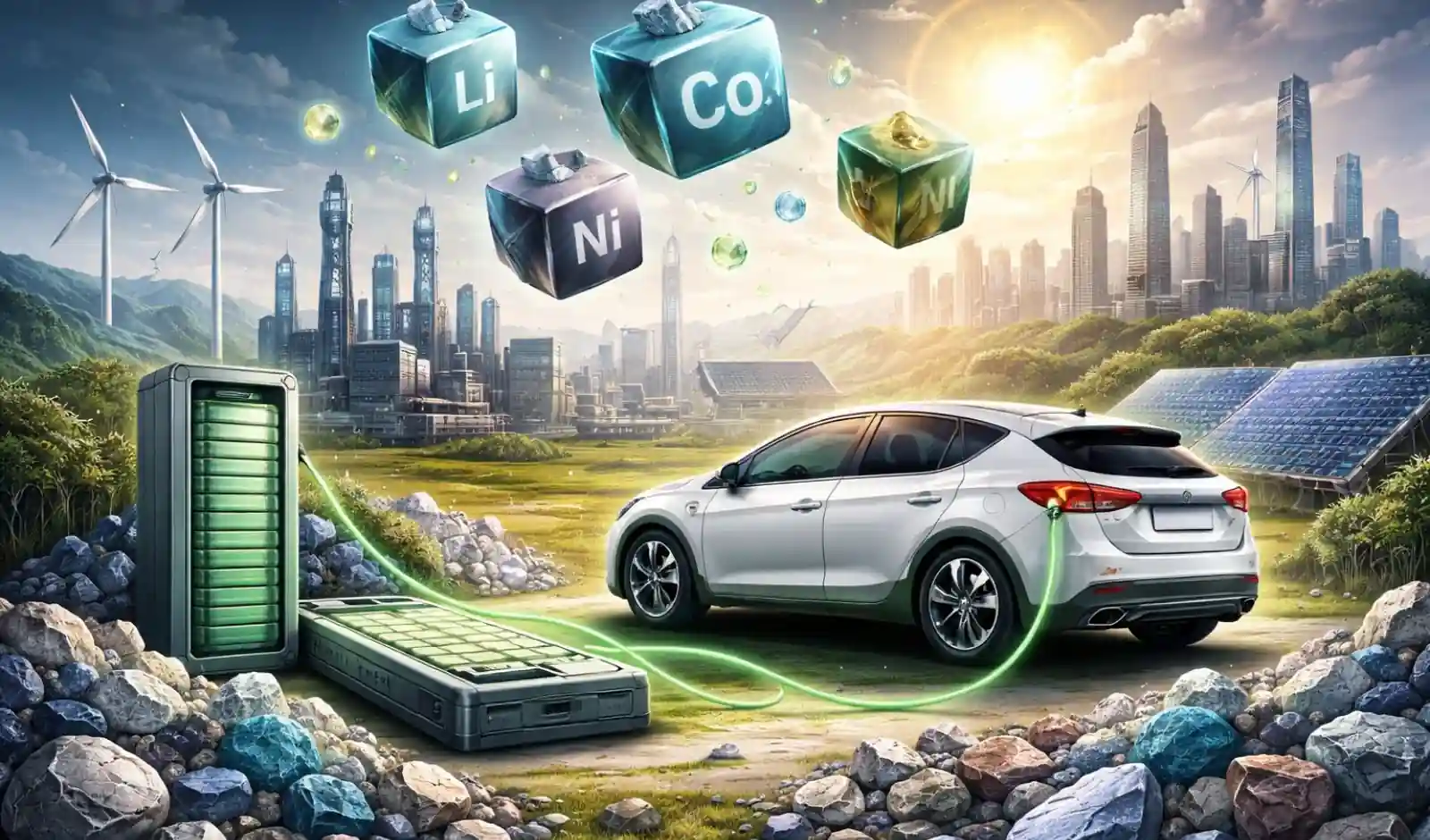
Electric vehicles (EVs) are no longer just a mode of transportation; they have become a key component of energy security, industrial development, and national strategy. At the heart of this transformation are critical minerals such as lithium, cobalt, nickel, and rare earth elements that are essential for EV batteries and motors.
The Economic Survey 2025-26 has highlighted the rising global competition for these minerals. Many countries are actively securing supplies, creating a scenario akin to a “new colonial race.” Strategic sectors like renewable energy, electric vehicles, semiconductors, and artificial intelligence are now top priorities. Consequently, EVs have evolved from an environmental or transportation concern to a matter of national security.
Why Critical Minerals Matter for EVs
The performance, cost, and adoption of EVs are deeply tied to the availability of these minerals. Lithium and nickel determine battery capacity and lifespan, cobalt ensures stability and safety, while rare earth elements enhance the efficiency and durability of EV motors.
According to Sameer Moidin, Founder & CEO of EVeium Smart Mobility, said these Critical minerals are important for electric vehicles because they determine not only battery performance but also the cost structure and long term viability of the entire EV ecosystem. Lithium and nickel influence range and charging behaviour, while rare earth elements affect motor efficiency and durability, making these materials central to everyday user experience and manufacturing economics. For electric two wheelers, where affordability and reliability drive adoption, any disruption in mineral supply or sharp price movement directly translates into higher vehicle prices and slower market growth.
The Economic Survey’s emphasis on critical minerals is therefore significant because it positions supply security alongside manufacturing capacity as a condition for long-term growth. It recognises that building battery plants without securing raw materials only shifts dependence to an earlier stage of the chain. The global competition it describes suggests that future EV strategies will be influenced as much by diplomacy and partnerships as by industrial policy. A more durable pathway will require coordinated action across overseas sourcing, domestic recycling and faster adoption of battery chemistries that reduce exposure to scarce inputs. Only then can EV expansion remain predictable rather than vulnerable to external disruptions.
On this topic Gaurav Dolwani, CEO and Founder, LICO Materials said "Critical minerals are essential to electric vehicles because they define not only battery chemistry but also the long-term sustainability of the EV ecosystem. As India scales up electric mobility, access to these minerals will increasingly shape cost stability, supply continuity and strategic autonomy. The Economic Survey appropriately underlines the urgency of securing critical mineral supply chains, but the solution for India cannot rely on imports alone. A strong domestic recycling ecosystem must be treated as a parallel source of critical minerals. By enabling battery recycling at scale, improving end of life traceability, and encouraging the use of recycled materials in new batteries, India can reduce resource risk while advancing Atmanirbhar Bharat. Policy clarity and market alignment will be crucial to converting this opportunity into a durable competitive advantage."
Economic Survey Perspective
The Economic Survey emphasizes that establishing battery manufacturing facilities alone is insufficient if the supply of raw materials remains insecure. India’s ACC Battery PLI scheme, with an investment of ₹18,100 crore to create 50 GWh battery capacity, strengthens the EV ecosystem. However, India still relies heavily on imports for lithium, cobalt, and nickel. Any disruption in global supply or price fluctuations could increase EV costs and affect adoption rates.
Manikumar Uppala, Co Founder and Chief of Industrial Engineering at Metastable Materials Said Critical minerals are at the core of the electric vehicles (EV) ecosystem. The batteries used for energy storage are arguably the most important part for EVs and critical minerals are essential for manufacturing lithium ion batteries and for charging infrastructure. This means that without secure access to these minerals, it is impossible to adopt EVs on a large scale.
EVs require high energy density batteries. For this, lithium and nickel are essential as Lithium provides the charge carrying ions and Nickel is an important cathode material for enhancing energy density. Cobalt and Manganese improve battery stability and lifespan. Since the global demand for EVs and energy storage is rising, the competition for these minerals is also increasing, exposing supply chains to geopolitical risks, price volatility and resource concentration in a few countries. For India, the transition into a low carbon economy, is marred with the challenges posed by the supply of critical minerals as the country is heavily import dependent for most of these minerals.
The Economic Survey rightly focuses on this vulnerability and places strategic importance on securing the critical minerals’ supply chain. Diversification of sourcing, overseas mineral asset acquisition, domestic exploration and recycling are some timely measures suggested for securing the critical minerals requirement. The Economic Survey notes that recycling and circular economy models are long term solutions to reduce dependence on primary mining as well as addresses environmental concerns. Overall, it adopts a forward looking stance by linking critical minerals directly to India’s EV ambitions and strategic autonomy
The Biggest Challenge
As Nitin Gupta, Co-founder & CEO of Attero, points out, the availability of critical minerals will determine how strong a country becomes in the EV and clean energy sectors. These minerals are no longer just an industrial requirement they have strategic importance. India now has an opportunity to reduce import dependence by improving domestic recycling and recovery, including extracting minerals from old electronics and spent batteries, creating a stable and sustainable supply chain.
Manufacturing Alone Is Not Enough
Himanshu Arya, Founder & CEO of Luxury Cart, explains that discussions in the EV sector have quickly shifted from vehicles to batteries and their raw materials. Manufacturing incentives alone cannot drive the sector forward. Long-term growth will depend on how raw material sourcing, processing, and supply chains are managed.
The Economic Survey signals that critical minerals are now a question of strategic self-reliance and national security. For India, the way forward lies in a balanced approach: securing international supply, strengthening domestic recycling, and adopting battery technologies that reduce reliance on scarce minerals. This strategy will ensure that the EV sector develops sustainably, reliably, and for the long term.


