


 103
/
5
Min Read
103
/
5
Min Read


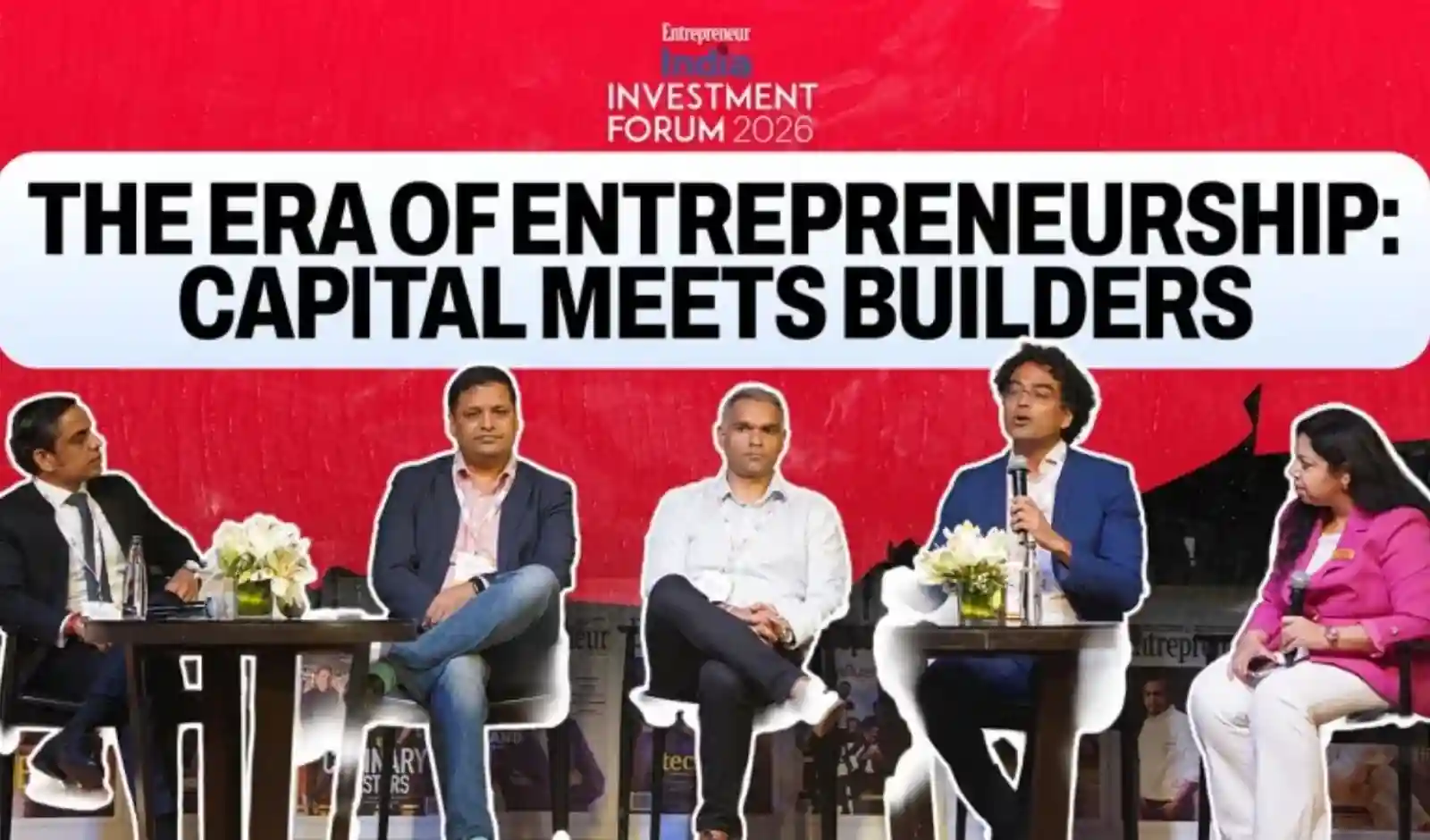
The Entrepreneur India Investment Forum 2026, held on 9th July at The Westin Mumbai Garden City, saw an enthusiastic turnout of founders, investors, family offices and industry leaders. As the forum commenced, the panel discussion on “The Era of Entrepreneurship: Capital Meets Builders” got underway, focusing on the future of an ecosystem that has seen the raise of over $171 billion from hypergrowth, profitability, governance, founder wealth and long-term value creation.
With India’s startup ecosystem witnessing the next phase of evolution, there is a shift towards balancing hypergrowth with governance, disciplined execution and long-term value creation. The panel discussion witnessed a confluence of these very topics.
Moderated by Punita Kapoor, Managing Editor, Entrepreneur India, the panel discussion featured Adhil Shetty, Founder & CEO, BankBazaar; Subeer Monga, Partner, Soren Investments; Vinod Murali, Co-founder & Managing Partner, Alteria Capital and Piyush Bansal, Head - Aditya Birla Ventures, who spoke about how founders and investors can navigate the next phase of entrepreneurship, ranging from AI to governance, IPO readiness and founder wealth.
The discussion began with Shetty being asked how BankBazaar has navigated through various regulatory cycles and how he finds newer opportunities in the ecosystem. He responded by saying that India continues to provide exciting opportunities for entrepreneurs to build large businesses every five years. Shetty further said that AI has been a huge disrupter for the company as the Bank now uses AI agents for video KYC apart from the systems creating thousands of marketing campaigns. “AI has occupied seats and this is not just about replacement but we are building entirely new systems that we couldn’t have thought of two years back,” he added.
The conversation then shifted to Monga, who was asked whether AI has changed the investment thesis or the kind of opportunities investors are looking at. Monga responded by saying that India’s AI narrative would be significantly different from the rest of the world as the technology would be deployed to drive productivity and organisation, unlike in developed markets where it was being used to offset labour costs. He further said, “India’s AI journey will be materially different from the narrative in the US. We will see a different kind of disruption.”
“When it comes to opportunities, we will see another India emerge in the next seven years. It will happen in our lifetimes and it will be a once-in-a-lifetime opportunity,” added Monga.
Murali then added that apart from the AI disruption, there has been a huge rise in domestic capital, apart from founders becoming more sophisticated and funding sizes increasing. However, he felt that execution continues to be the key differentiator for most startups. “The biggest thing we tell our founders is that the mistakes have to be small and the wins have to be big,” he said, adding that while every few years brings in a new technology wave or investment paradigm, execution continues to be the key differentiator for most startups.
When it came to what investors look for when backing founders, Bansal was invited to the discussion to share Aditya Birla Ventures’ investment thesis. He said that there were four key parameters that every deal was evaluated on - opportunity size, leadership potential, positive unit economics and founder motivation. “Opportunity size, leadership potential, positive unit economics, and founder motivation remain the four pillars of every investment decision. Scale only matters when the business fundamentals are strong,” he added, saying that investors were now looking for founders who had the staying power to realise long-term value.
The discussion then turned to the evolving relationship between founders and investors, with Punita asking the panel to share some learnings or instances where value was created beyond capital. Shetty responded by saying that investors often added value by helping banks with their needs, such as introducing them to partners or helping them navigate complex transactions. “Very often you’re going through things for the first time, but your investor has seen it 50 times,” he said.
Monga added that Soren actively helped founders with their hiring, customer acquisition, and operational needs, while Murali and Bansal said that founders now expect more from their investors in terms of strategic support.
The conversation then turned to IPO readiness and governance, with Murali saying that governance expectations were now being set even at the Series B stage, with founders needing to think through the kind of governance structure that would be needed at the scale of a public listing. “There’s no room for ‘I will just keep burning.’ That ship has sailed,” he added.
Bansal said that IPO readiness had to be thought through years in advance with founders needing to set up systems and processes well in advance.
As the discussion drew to a close, the panel turned to how founders and investors could evolve their relationship to think through ways to create more value. While founders had ambition and imagination, investors brought in a certain level of discipline to the table, helping build better organisations. Bansal concluded the discussion by saying that the future of entrepreneurship in India was extremely exciting. “The next phase of Indian entrepreneurship will actually be a lot bolder and will be a lot more ambitious. Very interesting times ahead for the Indian startup ecosystem.”
 This article was originally
published by the
This article was originally
published by the 


