


 66
/
4
Min Read
66
/
4
Min Read


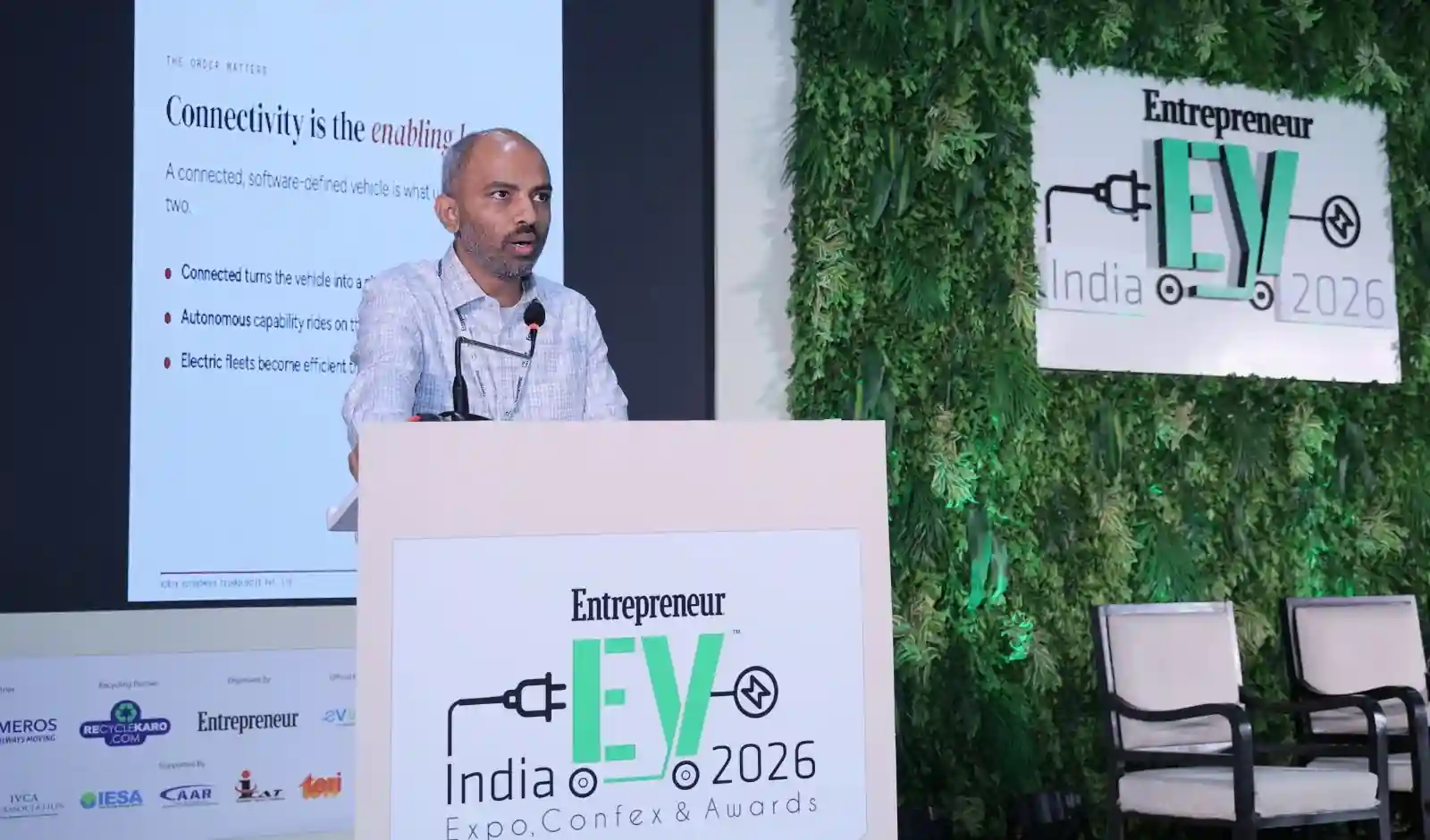
The future of electric mobility in India will extend far beyond electric vehicles, evolving into an ecosystem of connected, software-defined, and autonomous mobility. However, India's path will be different from that of other countries due to its unique road conditions, traffic patterns, and mobility challenges. This was stated by Sabarish Gurusubramanian, CTO of Virya Autonomous Technologies Pvt. Ltd., during his keynote session titled "The Next Inflection: Autonomous, Connected & Electric – India's Practical Path."
He explained that Virya Autonomous Technologies is part of the MINI Group, a design and manufacturing conglomerate established in 1973. The group also developed Reva, India's first mass-produced electric car. Building on this legacy, the company is now developing autonomous mobility solutions for the Indian market.
Connectivity Is No Longer Just a Feature
Sabarish said that connected vehicles were once associated mainly with infotainment and roadside assistance. Today, connectivity has become the foundation for continuously improving a vehicle throughout its lifecycle. This forms the basis of Software Defined Vehicles (SDVs), where most vehicle capabilities can be enhanced over time through software updates and data.
He added that Physical AI—intelligence embedded in machines—will become an integral part of every mobility platform in the future. It will drive the evolution of driver assistance systems, autonomous vehicles, and intelligent electric mobility solutions.
Autonomous Technology Is Already Operating in India
Virya Autonomous Technologies has already developed fully autonomous electric mobility platforms that transport people and materials within controlled industrial environments. The company has deployed more than 90 autonomous robots across factories in India, collectively completing over 166,000 hours of autonomous operations. According to him, this demonstrates that autonomous technology is no longer a vision for the future but a reality in India today.
India Needs a Different Approach to Autonomy
Sabarish emphasized that Advanced Driver Assistance Systems (ADAS) and autonomous technologies developed for India cannot simply replicate global models. Since lane markings on Indian roads are often inconsistent and drivers frequently create their own driving corridors, autonomous systems must understand the entire drivable space rather than relying solely on lane markings.
He also pointed out that Indian traffic is largely based on continuous negotiation among road users. Drivers constantly interpret each other's behavior before making decisions. Developing AI capable of understanding this dynamic driving behavior represents both a major challenge and a significant opportunity for India.
Smart Assistance, Not Excessive Alerts
He warned that if vehicles continuously generate alerts for every perceived obstacle, drivers will eventually suffer from alert fatigue and begin ignoring safety systems altogether. Therefore, ADAS solutions for India must be intelligent enough to provide warnings only when genuinely necessary.
He further stressed that with the country's large two-wheeler population, driver assistance systems must be specifically trained to recognize and understand two-wheelers and their unique riding behavior to significantly improve road safety.
Huge Potential in Controlled Environments
According to Sabarish, fully autonomous vehicles on public roads may still take time, but factories, warehouses, industrial campuses, and other controlled environments already offer enormous opportunities for autonomous electric mobility. Low speeds, defined operating conditions, and controlled surroundings make these environments ideal for deploying autonomous systems safely and efficiently.
However, he noted that ensuring safe collaboration between robots and human workers will remain one of the biggest challenges, requiring data-driven testing, continuous monitoring, and gradual deployment.
Data and Energy Will Shape the Future
Sabarish said that data generated by connected and autonomous vehicles will play a crucial role in improving energy management. It will help enhance battery efficiency, reduce operating costs, and maximize vehicle utilization.
He also highlighted battery swapping as a key component of India's electric mobility future. According to him, when vehicles become fully connected and autonomous, battery swapping will enable continuous operations with virtually no downtime, eliminating long charging periods and significantly reducing range anxiety.
Software Deserves Equal Attention Alongside Hardware
Concluding his keynote, Sabarish said India has made remarkable progress in EV hardware, battery technology, charging infrastructure, and manufacturing. However, the country must now invest equally in developing the software layer, artificial intelligence, and data platforms that power next-generation mobility.
He concluded by saying that India possesses world-class engineering talent and technical capabilities. By focusing on software-driven mobility alongside hardware innovation, India has the potential to become a global leader in autonomous and electric mobility.


