


 54
/
4
Min Read
54
/
4
Min Read


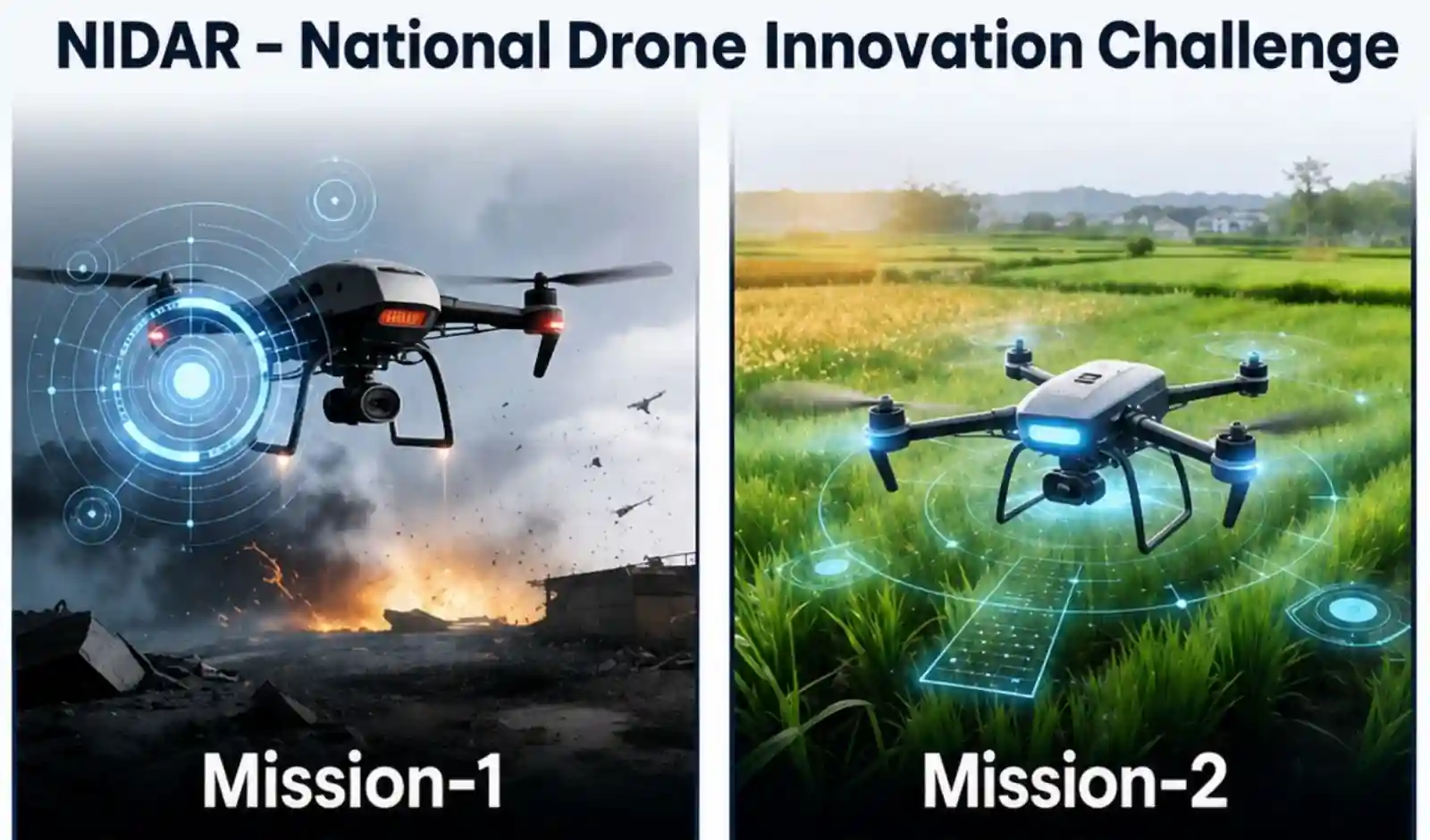
The initiative aims to connect students across the country with emerging technologies such as drone engineering, Artificial Intelligence (AI), semiconductor design and indigenous hardware innovation. The launch event, held at Electronics Niketan in New Delhi was attended by students, academicians, government officials and industry leaders from across India.
Under NIDAR 2.0, students have been challenged to develop smart and fully autonomous drones powered by India's indigenous VEGA processor. The competition offers a prize pool of more than INR 6.5 million (INR 65 lakh). In addition to cash awards, winning teams will receive startup incubation support, corporate internships, cloud computing credits, software support and technical mentorship to help transform their prototypes into commercially viable products.
During the launch event, MeitY Secretary S. Krishnan unveiled the NIDAR 2.0 rulebook, poster and problem statement. The event was also attended by Amitesh Kumar Sinha, Additional Secretary, MeitY and CEO of the India Semiconductor Mission; Tulika Pandey, Scientist-G and Group Coordinator and Smit Shah, President of the Drone Federation India. Senior representatives from the Ministry of Civil Aviation, Ministry of Defence, Ministry of Home Affairs, DGCA, the Armed Forces, academic institutions and the industry also participated in the programme.
S. Krishnan: Indian Students Will Build the ‘Brain’ of Future Drones
Speaking at the event, S. Krishnan said that NIDAR 2.0 goes beyond teaching students how to fly drones and instead encourages them to build the "brain" that powers them. He said that running drone control systems on India's indigenous VEGA processor will help reduce the country's dependence on foreign chip designs and expensive licensing. He added that the VEGA processor has been developed under the Digital India RISC-V (DIR-V) programme to promote indigenous microprocessor technology.
This edition of NIDAR will be conducted through two separate tracks. The first, Drone Innovation, challenges student teams to develop fully autonomous swarm drones capable of locating survivors in disaster-hit areas and delivering medical supplies without relying on external communication networks. Teams will also be required to develop GPS-denied drones capable of safely navigating confined indoor spaces for industrial inspection.
The second track, Component Innovation, requires participants to design indigenous flight controllers and autopilot systems using locally developed electronic components based on the VEGA processor. Following technical evaluation, the top 100 teams will receive two VEGA processor development kits each for development, testing and system integration.
VEGA Processor to Strengthen Indigenous Drone Technology
The VEGA processor is a family of indigenous microprocessors based on the open-standard RISC-V architecture, designed by the Centre for Development of Advanced Computing (C-DAC) under MeitY's Microprocessor Development Programme. Through NIDAR 2.0, students will get the opportunity to build drone control systems using Indian-designed chips for the first time. The initiative is expected to accelerate innovation in semiconductor design, embedded electronics and advanced drone technologies in India.
Considering the expanded scope of the competition, the total prize money has been increased to more than INR 6.5 million. In addition to cash prizes, winning teams will receive startup incubation support, cloud computing resources, technical assistance and corporate internship opportunities. The government aims to ensure that promising student innovations evolve beyond the competition stage into successful startups and commercial products.
According to MeitY, many of the core technologies used in civilian and defence drones are similar. As a result, innovations emerging from NIDAR 2.0 have the potential to support India's Atmanirbhar Bharat vision and the Viksit Bharat @2047 mission. The initiative is expected to prepare students for careers in emerging sectors such as defence, agriculture, disaster management, logistics and industrial inspection.
Building on the Success of the First Edition
The first edition of NIDAR was launched in March 2025, attracting participation from 3,448 students across 22 states, four Union Territories and 109 cities. Students developed autonomous drone solutions for disaster management and precision agriculture. A total of 93 teams qualified for the Grand Finale, while 24 teams won prizes worth INR 4 million (INR 40 lakh). Following the success of the inaugural edition, NIDAR 2.0 has been designed to be more technology-driven, application-oriented and industry-focused.
NIDAR 2.0 is part of MeitY's SwaYaan initiative, which was approved in July 2022 with an outlay of nearly INR 898.7 million (INR 89.87 crore) over five years. The initiative aims to develop a highly skilled drone workforce in India and is being implemented through 30 premier institutions, including IISc, IITs, IIITs, NITs, C-DAC and NIELIT.
So far, more than 51,000 students, faculty members and professionals have received training in drone technologies under the initiative. The programme has also promoted M.Tech courses, minor degree programmes, online courses, research projects and patent development. Experts believe that NIDAR 2.0 is not merely a competition but a significant national initiative that will strengthen India's future capabilities in drone technology, Artificial Intelligence, robotics and semiconductor innovation.


