


 925
/
5
Min Read
925
/
5
Min Read


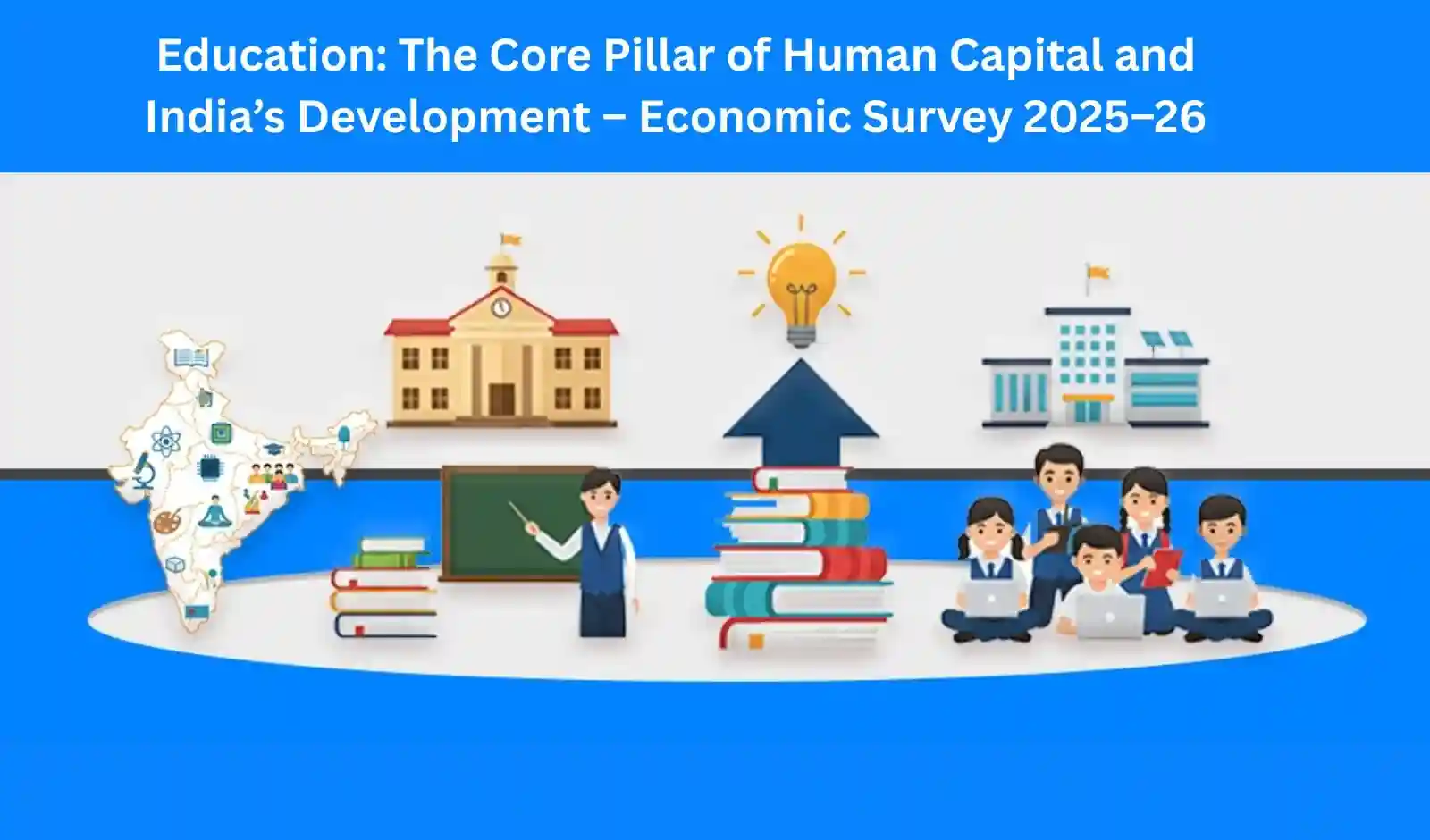
Education can become more useful and relevant when young people receive job-ready skills on time and schools are developed as centres of lifelong learning. According to PLFS 2023-24, only 0.97 percent of youth in the 14-18 age group have received institutional training, while nearly 92 percent have not received any formal training.
To fully benefit from India’s demographic dividend, it is crucial to bridge this gap. Providing skill education in schools will prepare young people in line with market requirements, especially for the services sector, which provides the largest share of employment to formally trained youth. This will help link education with economic opportunities and reduce school dropout rates.
Higher Education
The number of Higher Education Institutions (HEIs) stood at 51,534 in 2014-15 and increased to 70,018 by June 2025. This growth has been driven by a significant rise in the number of universities and colleges. Between 2014-15 and 2024-25, the number of premier higher education institutions also increased substantially. At present, the country has 23 IITs, 21 IIMs and 20 AIIMS. In addition, two international IIT campuses have been established in Zanzibar and Abu Dhabi.
According to the All India Survey on Higher Education 2022-23 (provisional data), student enrolment increased from 43.3 million in 2021–22 to 44.6 million in 2022-23.
Under the National Education Policy (NEP), several reforms have been introduced in the higher education system. A national credit-based framework has been adopted in 170 universities with the objective of integrating education with skill-based learning. The Academic Bank of Credit has been implemented across 2,660 higher education institutions. Under this system, more than 46 million identification cards have been issued, including 22 million APAAR IDs.
To achieve the NEP target of a 50 percent Gross Enrolment Ratio (GER) by 2035, flexible entry and exit pathways have been introduced in 153 universities, along with the provision of admissions twice a year. In line with the NEP, the National Research Foundation has been established to promote research and innovation. Its aim is to encourage a research-oriented education culture across universities, colleges and research institutions nationwide.
To improve the quality of technical education, a multidisciplinary education and research reform scheme has recently been approved. This scheme will be implemented in 275 technical institutions, including 175 engineering colleges and 100 polytechnics.
Industry-Academia Integration in STEM Education
The NEP aims to integrate vocational training with general education and promote collaboration between industry and academia within higher education institutions. Traditionally, industry-academia engagement has focused on research collaboration, consultancy and technology transfer.
In this direction, the UGC and AICTE have introduced the category of ‘Professor of Practice’ in higher education institutions. This allows experienced industry professionals to bring real-world practices and experiences into classrooms and helps address faculty shortages. Complementing this initiative is the AICTE-Industry Fellowship Programme, which seeks to bridge the gap between academia and industry through active faculty participation.
Internationalisation of Higher Education
The NEP seeks to make the Indian education system self-reliant and aligned with global standards, thereby internationalising higher education. The objective is to attract more foreign students to study in India and reduce the need for Indian students to go abroad.
In 2022, the UGC issued regulations on academic collaboration between Indian and foreign higher education institutions. These regulations enable Indian institutions to partner with reputed foreign universities to offer twinning, joint and dual degree programmes. In addition, 100 percent Foreign Direct Investment (FDI) has been permitted in the higher education sector.
These efforts are further strengthened by the UGC’s 2023 regulations, which allow foreign higher education institutions to establish campuses in India. It is expected that around 15 foreign higher education institutions will set up campuses in the country.
With the introduction of the National Education Policy, updated UGC guidelines, regulations on academic collaboration and mutual recognition of qualifications and permissions for foreign campuses in areas such as GIFT City, India’s policy environment for the internationalisation of higher education has become more conducive.
To build a future-ready workforce and fully harness the country’s potential, focused attention on the education sector is essential. This requires advancing education reforms through an integrated, accountable and flexible policy framework.
Educational Achievements
According to the Economic Survey 2025-26, the education sector has recorded several significant achievements. These include an increase in literacy rates, higher enrolment in schools and higher education institutions and improved provision of vocational education.
The Gross Enrolment Ratio (GER) has reached 90.9 percent at the primary level and 90.3 percent at the upper primary level, The country now has 23 IITs, 21 IIMs and 20 AIIMS, along with two international IIT campuses in Zanzibar and Abu Dhabi, Under the Academic Bank of Credit, 2,660 institutions have been integrated and more than 46 million identification cards have been issued and To achieve the NEP target of 50 percent GER by 2035, flexible entry-exit systems have been implemented in 153 universities, along with the provision of admissions twice a year.
Indian higher education institutions are now partnering with reputed foreign universities to offer joint and dual degree programmes and around 15 foreign higher education institutions are expected to establish campuses in India. Therefore, as per the Economic Survey 2025-26, structured skill development is being introduced in secondary schools with the objective of ensuring the early availability of employment-oriented skills.


