


 88
/
4
Min Read
88
/
4
Min Read


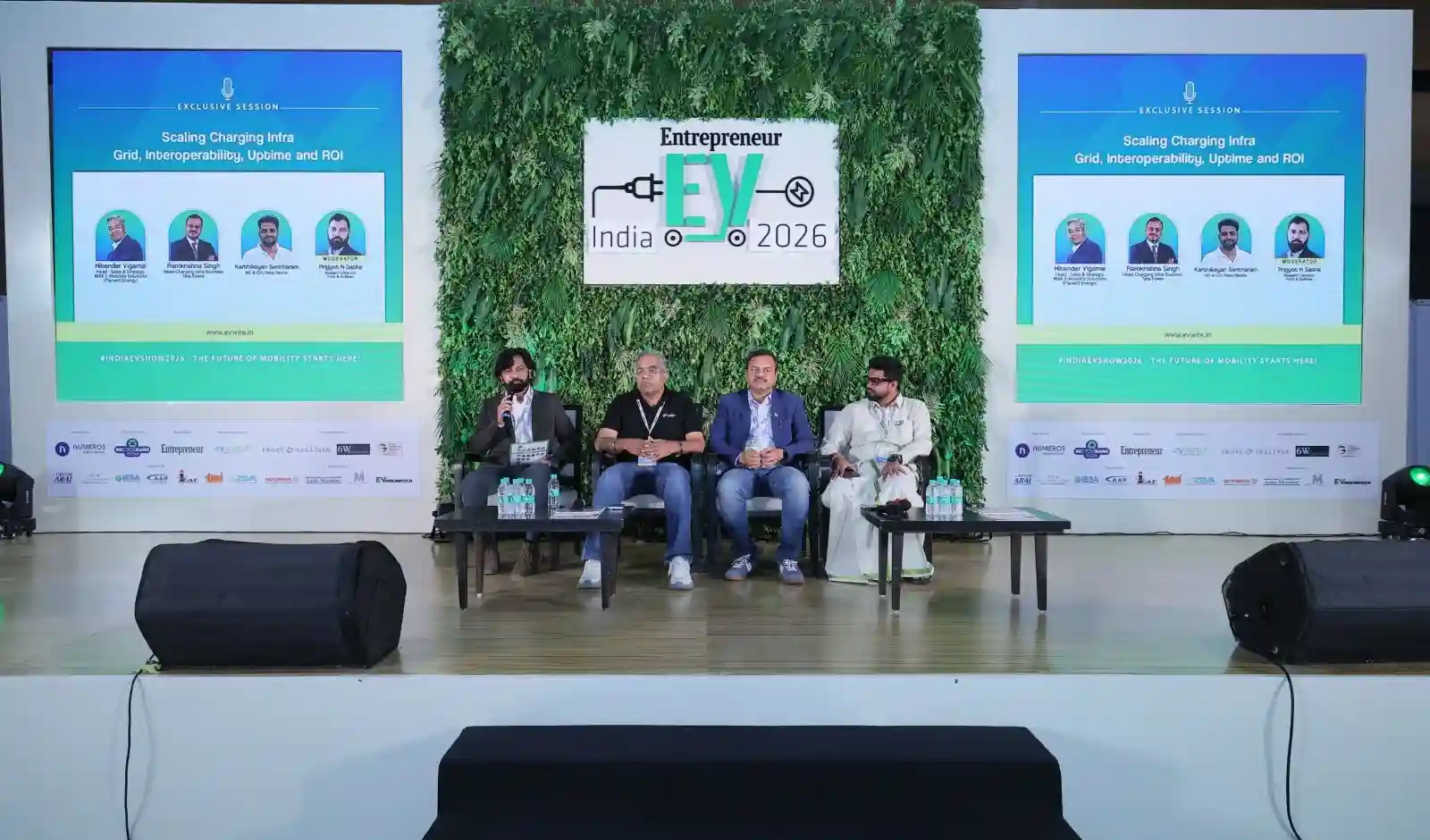
As electric vehicle adoption accelerates across India, building a fast, reliable, and economically sustainable charging infrastructure has become one of the industry's top priorities. Merely increasing the number of charging stations will not be enough. Ensuring high uptime, seamless grid interoperability, smart energy management, superior quality, and strong return on investment (ROI) will be equally critical.
These themes were discussed in detail during the panel session, "Scaling Charging Infrastructure: Grid, Interoperability, Uptime and ROI," moderated by Prajyot N. Sathe, Research Director, Frost & Sullivan. The panel featured Hitendra Vigamal, Head – Sales & Strategy, MAK E-Mobility Solutions (Planet 3 Energy); Ramkrishna Singh, Head – Charging Infrastructure Business, Tata Power; and Karthikeyan Santharam, MD & CEO, Relux Electric. The experts agreed that the future of EV charging in India will not be driven by installing more chargers alone, but by AI-enabled predictive maintenance, smart grids, reliable charging networks, transparency, efficient energy management, and sustainable business models. Charging stations are expected to evolve into smart energy hubs that will power the next phase of India's EV ecosystem.
What will be the biggest differentiator for charging infrastructure companies over the next 5–6 years?
Hitendra Vigamal: The charging industry will move beyond simply deploying more chargers. Success will depend on efficient energy management, reliability, and high-quality charging solutions. High-power DC chargers, a balanced mix of AC and DC charging, and improved charger utilization will shape the market. Companies capable of delivering reliable and durable charging infrastructure will emerge as long-term market leaders.
What role will AI, predictive maintenance, and remote diagnostics play in achieving more than 95% uptime?
Hitendra Vigamal: AI-powered predictive maintenance will identify potential failures before they occur. In the future, chargers will be able to alert operators 15–30 days in advance about components that require servicing or replacement. This will significantly reduce downtime, improve operational reliability, and increase network availability.
What will be the biggest transformation in India's charging industry over the next five years?
Hitendra Vigamal: Transparency will become the industry's biggest transformation. Charger manufacturers should publicly disclose real-world uptime, performance, and error data. At the same time, India needs clear national standards for charger power ratings so that investors and Charge Point Operators (CPOs) can accurately evaluate charger performance.
What is the biggest challenge in scaling charging infrastructure in India?
Ramkrishna Singh: The biggest challenge is ensuring economic viability and a healthy return on investment (ROI). Equally important are charger reliability, proper site selection, uninterrupted 24×7 power supply, and technologies designed specifically for Indian climatic and operating conditions. Charging infrastructure must be developed to suit India's unique environment.
Can India's power grid support the growing demand for EV charging in the future?
Ramkrishna Singh: The grid is capable of supporting today's demand, but electrification of buses, trucks, and heavy commercial vehicles will significantly increase electricity requirements. To meet future demand, India will need smart charging stations, rooftop solar systems, battery energy storage, and Vehicle-to-Grid (V2G) technologies. Future charging stations will evolve from being mere electricity consumers to becoming energy producers and storage hubs.
Can public charging become profitable by selling electricity alone?
Karthikeyan Santharam: No. Selling electricity alone is unlikely to create a sustainable business. Charging stations must evolve into complete charging hubs offering customer amenities such as waiting lounges, retail outlets, food services, and other convenience facilities. Strong branding, reliable service, and a robust business model will be the keys to profitability.
Why is reliability so critical for charging networks?
Karthikeyan Santharam: When a charger fails, customers rarely distinguish whether the issue lies with the charger, the vehicle, or the power supply—they simply lose trust in the brand. Therefore, ensuring consistent and reliable charger performance is far more important than merely increasing the number of charging stations. Reliability will become the defining factor for every Charge Point Operator (CPO).
Will India future rely more on AC charging or DC fast charging?
Karthikeyan Santharam: Considering limited parking availability and power distribution challenges in Indian cities, DC fast charging will play a much larger role. Installing AC chargers in every home is not practical in densely populated urban areas. Therefore, a widespread, reliable, and high-speed DC charging network will be essential for accelerating EV adoption.
Conclusion
The panel concluded that the next phase of India's EV charging infrastructure will not be defined by the number of charging stations installed, but by reliability, smart energy management, AI-driven maintenance, stronger grid integration, greater transparency, and sustainable business models. In the coming years, charging stations are expected to evolve into integrated energy hubs, providing the foundation for the rapid expansion of India's electric mobility ecosystem.


