


 152
/
6
Min Read
152
/
6
Min Read


Electric vehicle (EV) manufacturing has emerged as one of the fastest-growing segments of the global automotive industry, playing a crucial role in advancing clean energy, sustainable mobility, and resilient supply chains. Backed by local manufacturing, technological innovation, and supportive government policies, India is steadily positioning itself as a global hub for EV manufacturing.
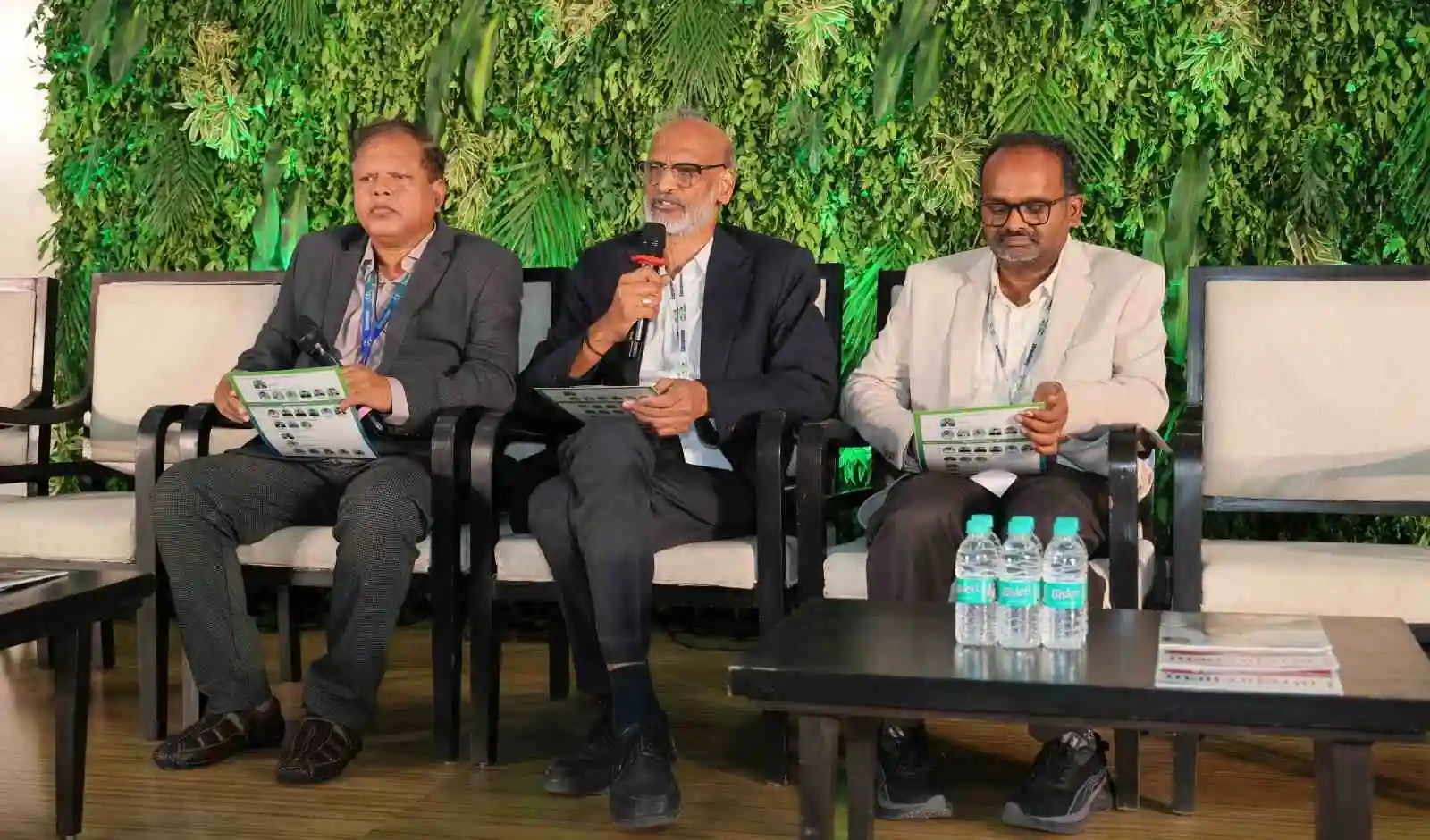
The panel discussion on "EV Manufacturing for the World: Scale, Challenges and India's Edge" was moderated by I.V. Rao, Distinguished Fellow, TERI, and featured Sivaramakirushnan J, Director – Manufacturing Process Engineering, Stellantis India, and Jitendra Patil, Head – EV Cell, Government of Maharashtra, as speakers.
Setting the context, I.V. Rao highlighted that India's electric mobility journey began in 2013 with a vision that extended beyond EV adoption. The primary objectives were to strengthen energy security, reduce dependence on crude oil imports, and address rising air pollution. He noted that India is now manufacturing EVs across all segments—from two-wheelers to buses—but continued dependence on imported batteries and critical components keeps vehicle costs high. To achieve large-scale EV adoption and establish itself as a global EV manufacturing hub, India must focus on increasing localization, reducing manufacturing costs, and building a robust supply chain. Against this backdrop, the panel discussed key issues including EV manufacturing, battery technology, government policies, charging infrastructure, the circular economy, and the strategies required to enhance India's global competitiveness in EV manufacturing.
How is EV manufacturing different from conventional ICE vehicle manufacturing?
Sivaramakirushnan J: ICE vehicle manufacturing is a mature industry with well-established processes developed over decades. EV manufacturing, however, demands much higher precision, especially in battery and motor production. Some key differences include:
- Battery pack manufacturing requires humidity below 10% to prevent oxidation.
- Battery cells must be matched within 2% variation in internal resistance and capacity.
- Busbars need positioning accuracy within 200 microns.
- Torque variation during assembly must remain below 2.5%.
- Electric motors operate at 15,000–20,000 RPM, requiring extremely high manufacturing precision.
To maintain consistency, manufacturers rely on robotics, automation, IoT-based monitoring, and complete traceability systems. Even small manufacturing deviations can result in short circuits or thermal events.
How can India scale EV manufacturing while maintaining quality?
Sivaramakirushnan J: Scaling EV manufacturing is not just about investing in highly automated factories. It is about creating disciplined manufacturing processes that consistently deliver quality.
- Key requirements include:
- Standardized assembly processes
- Process traceability
- Appropriate automation
- Precision manufacturing
- Supplier quality management
The biggest challenge lies beyond OEMs. Tier-2 and Tier-3 suppliers must also adopt the same quality standards because the overall vehicle quality depends on the complete supply chain.
Should manufacturers build dedicated EV platforms or convert existing ICE platforms?
Sivaramakirushnan J: Both approaches have relevance. Converting ICE vehicles into EVs supports the principles of the circular economy by extending vehicle life while reducing emissions. Battery recycling and vehicle conversion together can significantly improve sustainability.
India should encourage startups that convert ICE vehicles into EVs, but they must follow OEM-level manufacturing standards to ensure safety and avoid risks such as thermal runaway.
With rising fuel prices, affordable ICE-to-EV conversions can benefit a large section of Indian consumers.
Can EV startups compete with established automobile manufacturers?
Sivaramakirushnan J: Yes, provided they consistently deliver high-quality products. Success will depend on:
- Reliable manufacturing processes
- Strong product validation
- Failure prevention through PFMEA and DFMEA
- Customer-focused product quality
- Legacy OEMs already possess manufacturing expertise, but startups with robust engineering and quality systems can also scale successfully.
How has Maharashtra promoted EV manufacturing and adoption?
Jitendra Patil: Maharashtra has adopted a comprehensive approach covering manufacturing, infrastructure and consumer adoption. Major initiatives include:
- EV Policy 2025
- 100% road tax exemption for EVs
- Additional demand incentives beyond central government support
- Promotion of EV manufacturing clusters in Pune and Chhatrapati Sambhajinagar
- Support for battery and component manufacturing
- Development of EV charging infrastructure
- Declaration of Mumbai–Pune and Mumbai–Nagpur as EV corridors
- 100% toll exemption for EVs on selected routes
- The state also coordinates multiple departments including Transport, Industry, Power, Urban Development and Environment to build a complete EV ecosystem.
What role does charging infrastructure play in EV adoption?
Jitendra Patil: Charging infrastructure is critical because customers value convenience. The government encouraged charging infrastructure by:
- Creating dedicated EV corridors
- Offering toll exemptions
- Increasing EV usage on highways
Once EV traffic increased, private charge point operators found the business viable and invested in charging stations. The Mumbai–Pune Expressway now hosts one of Maharashtra's most profitable charging networks.
Why is battery manufacturing considered the biggest challenge in EV localization?
Vijayanand (Former CEO, Amara Raja): Battery manufacturing represents nearly 40–45% of an EV's cost, making it central to India's localization strategy. Several challenges have shaped India's battery manufacturing journey:
- Demand uncertainty
- Policy consistency
- Technology selection (NMC vs LFP vs LTO)
- High capital investment and long payback periods
- Supply chain and critical mineral availability
- Availability of skilled manpower
- Unlike conventional automotive manufacturing, battery manufacturing is highly capital intensive, requiring patient investments and long-term policy support.
What are the key priorities for building a globally competitive EV manufacturing ecosystem in India?
Panel Consensus: India's ability to build a globally competitive EV manufacturing ecosystem will depend on strengthening every part of the value chain. The panel agreed that increasing local battery manufacturing, adopting high-precision manufacturing processes, and leveraging automation with digital traceability are essential to ensure quality and scalability. Developing a strong Tier-2 and Tier-3 supplier ecosystem, promoting battery recycling and circular economy practices, and expanding reliable charging infrastructure will further support sustainable growth. Equally important are stable and consistent government policies, a skilled workforce, and close collaboration between governments, OEMs, startups and MSMEs. Together, these elements can enable India to emerge as a global hub for EV manufacturing and exports.
Conclusion
The discussion highlighted that India's EV manufacturing ecosystem is progressing rapidly, supported by government policies, growing industry investments and increasing localization efforts. While battery manufacturing, supply chain development, charging infrastructure and skilled manpower remain key challenges, the panel agreed that quality, manufacturing discipline, innovation and collaboration across OEMs, startups, suppliers and governments will be critical to long-term success. With continued investment in technology, circular economy practices and policy stability, India has the potential to emerge as a leading global manufacturing and export hub for electric vehicles.


