



 117
/
3
Min Read
117
/
3
Min Read


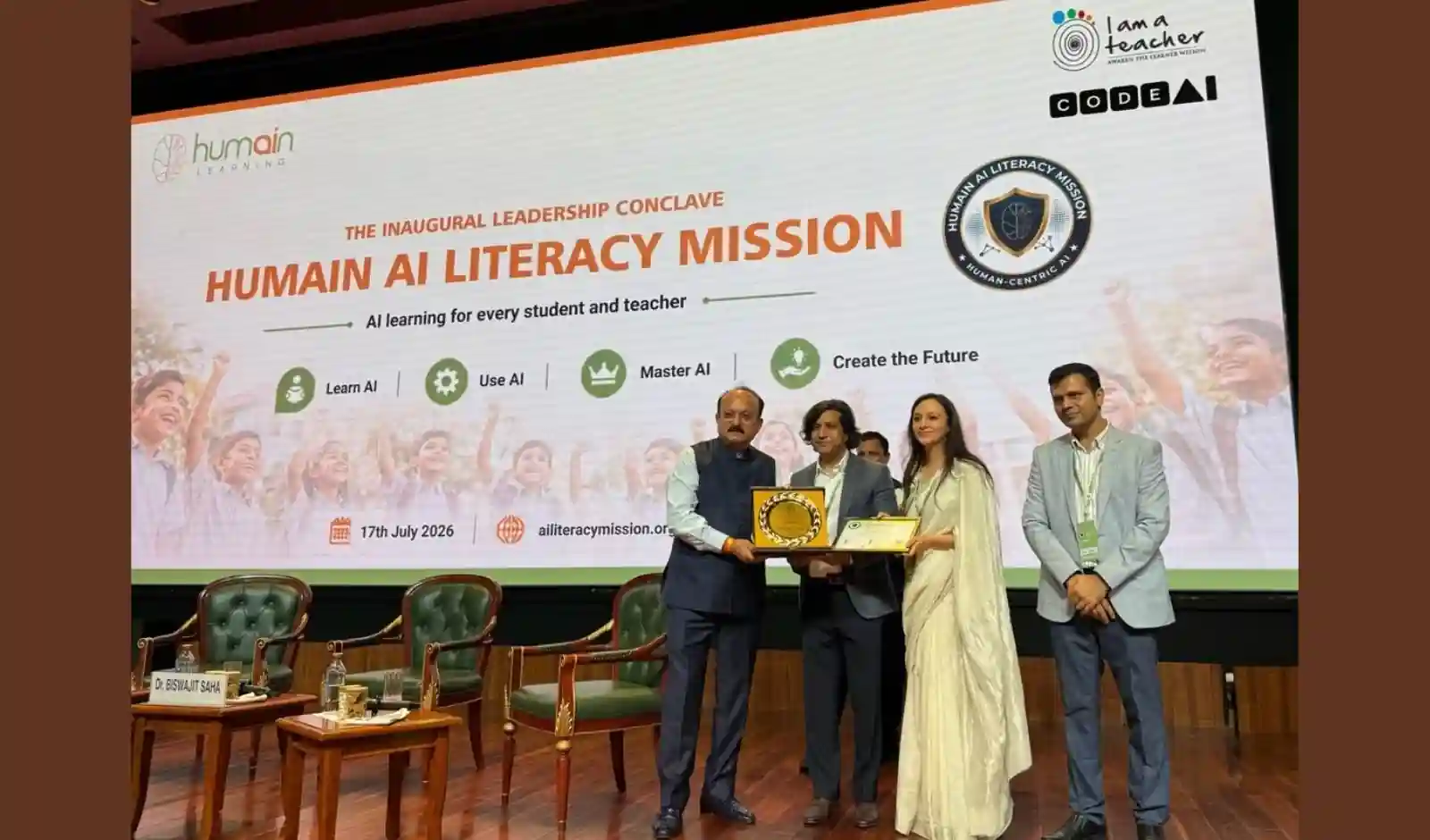
The HUMAIN AI Literacy Mission (HAILM) was formally launched at Bharat Mandapam, New Delhi, today, introducing a holistic approach to AI literacy that brings school leaders, teachers and students onto a structured learning pathway. Combining an age-appropriate curriculum for Grades 3 to 12 with live sessions, an LMS, video lessons, interactive activities, teacher development, policy resources and classroom-ready learning materials, HAILM aims to help schools adopt AI education systematically with foundational-level learning available free to broaden access across geographies.
The launch comes at a time when artificial intelligence is becoming part of how young people learn, search for information, create content and interact with technology. Yet, access to structured learning that helps students understand how AI works, assess its outputs and recognise its limitations remains uneven. HAILM seeks to address this gap, enabling students to progress from foundational understanding to responsible and practical use.
Mr. Manit Jain, Chief Visionary, HAILM, outlined the whole-school thinking behind the mission. "AI has already started influencing how our children learn, work and make decisions. We must ensure they do not grow up merely as users of this technology, but understand its possibilities, limitations and responsibilities. Building an AI-literate Bharat requires a holistic approach that empowers school leaders to shape informed policies, teachers to guide responsible use and students to understand the technology shaping their future. By making foundational AI literacy freely accessible and supporting schools through a structured learning pathway, HAILM aims to democratise access to AI education and support the vision of Viksit Bharat 2047 by preparing a generation that can understand, use and shape emerging technologies responsibly.”
Explaining how the mission will translate this vision into practice, Mr. Amit Yadav, CEO, HAILM, said, “For AI literacy to become truly accessible, it has to work within the realities of Indian classrooms. We are designing HAILM as a structured pathway rather than a one-time intervention, with clear support for students, teachers and school leaders. Our aim is to build a model that schools can adopt with confidence across different contexts, while keeping responsible use central to how students encounter AI.”
Beyond classrooms, wider access to foundational AI literacy can help prepare young people to participate more meaningfully in India's digital future. As AI is embedded across sectors, early exposure to its responsible and informed use can equip students to engage with technology as informed users, creators and problem-solvers.
Addressing the launch, Shri Ashish Sood, Minister of Education, Government of NCT of Delhi, highlighted the importance of preparing students and educators for an AI-enabled world.
"Our classrooms have embraced the digital shift; the next step is ensuring students and teachers understand the AI systems shaping the world around them, safely and responsibly. Building this understanding early can help young people engage with technology with greater confidence and judgement. Initiatives that expand access to structured and inclusive AI learning can play an important role in preparing students to navigate emerging technologies responsibly," said Shri Ashish Sood, Minister of Education, Government of NCT of Delhi.
Following the launch, HAILM will focus on onboarding schools, expanding teacher-training cohorts and developing partnerships across school education, with further details on institutional collaborations and state-wise rollout to be announced as implementation progresses.
As HAILM moves from launch to implementation, its focus will be on translating its whole-school approach into meaningful classroom impact, helping build a generation that can understand, question and use AI with greater confidence and responsibility.


